Table of Contents
ToggleAgentic AI Architecture
Introduction to Agentic AI Architecture
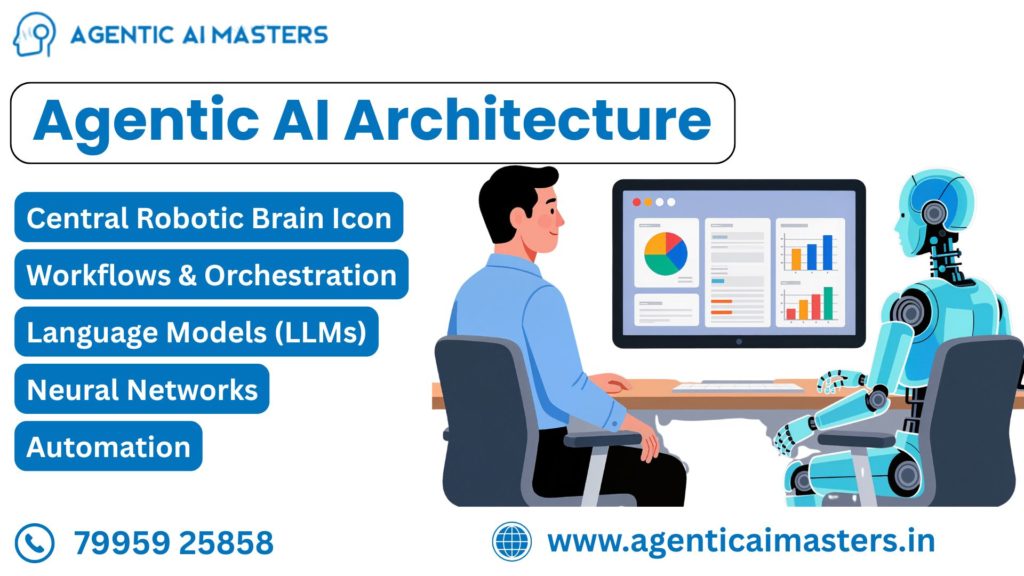
Agentic AI Architecture represents a new way of designing artificial intelligence systems where AI does not simply respond to inputs but acts as an autonomous agent capable of planning, executing tasks, and learning from outcomes. Instead of relying on a single prompt–response flow, this architecture is built around goal-driven agents that operate in continuous loops—observing their environment, making decisions, taking actions, and improving over time.
At its core, Agentic AI Architecture combines multiple capabilities into a unified system: large language models (LLMs) for reasoning, tools and APIs for execution, memory systems for context retention, and feedback loops for learning and adaptation. This design allows AI systems to move beyond static outputs and handle complex, real-world tasks that require multi-step reasoning and long-term context.
This architecture has become critical today because modern businesses and technologies demand autonomous, scalable, and context-aware intelligence. Traditional AI architectures struggle with dynamic environments, frequent changes, and end-to-end automation. Agentic AI solves this by enabling systems to operate independently, coordinate actions, and continuously optimize their behavior.
From enterprise automation and decision intelligence to autonomous software development and intelligent customer support, Agentic AI Architecture forms the foundation of next-generation AI systems. It marks a shift from AI as a tool to AI as an active participant in workflows, making it a key building block for the future of intelligent, autonomous systems.
What is Agentic AI Architecture?
Agentic AI Architecture refers to the structural design of AI systems where autonomous agents are capable of perceiving their environment, making decisions, taking actions, and learning from outcomes with minimal human intervention. Unlike simple AI pipelines, this architecture is built around goal-oriented agents that operate in continuous loops rather than one-time executions.
Key points:
- It is agent-centric, not prompt-centric.
- Combines LLMs, tools, memory, planning, and feedback loops into a single system.
- Designed to support long-running, adaptive, and self-improving behaviors.
- Enables AI systems to move from “answering” to acting and executing tasks.
- Forms the backbone of modern autonomous AI systems, including multi-agent workflows.
In short, Agentic AI Architecture defines how intelligent agents are structured, connected, and governed to operate autonomously in real-world environments.
Why Agentic AI Architecture Matters Today
Agentic AI Architecture matters because traditional AI systems are no longer sufficient for today’s complex, dynamic, and automation-heavy use cases.
Key reasons:
- Static AI is breaking down: Prompt-based and rule-based systems fail in real-world, evolving scenarios.
- Businesses need autonomy: Organizations want AI that can plan, execute, and optimize workflows end-to-end.
- Scale demands intelligence: Manual orchestration does not scale across large systems or teams.
- Real-time decision-making: Modern systems require AI that reacts to live data, not batch inputs.
- Foundation for enterprise AI: Agentic architectures support monitoring, governance, security, and cost control.
Today’s AI shift is not about better answers—it’s about autonomous outcomes, and Agentic AI Architecture enables that transition.
Agentic AI vs Traditional AI Architecture
Agentic AI Architecture is fundamentally different from traditional AI system design.
Key differences:
- Traditional AI follows a linear flow (input → model → output), while Agentic AI operates in continuous loops (perceive → plan → act → learn).
- Traditional systems are reactive, whereas agentic systems are proactive and goal-driven.
- Agentic AI includes memory and context persistence, unlike stateless traditional models.
- Traditional AI requires frequent human control; Agentic AI supports self-directed execution.
- Agentic architectures support tool usage, multi-step reasoning, and coordination across agents.
This shift moves AI from being a support tool to becoming an active system participant.
Real-World Problems Solved by Agentic Architectures
Agentic AI Architecture is built to solve problems that traditional AI cannot handle effectively.
Real-world problem areas include:
- Autonomous business workflows: AI agents managing SEO, marketing campaigns, reporting, and optimization.
- Customer support automation: Agents that understand issues, take actions, escalate intelligently, and learn from past tickets.
- Enterprise decision intelligence: AI systems that analyze data, simulate outcomes, and recommend or execute decisions.
- Software development automation: Agentic SDLC where agents write, test, review, and deploy code.
- Data engineering and analytics: Agents that ingest data, clean it, analyze patterns, and generate insights automatically.
- Multi-agent coordination: Complex tasks split across specialized agents working together.
These problems require continuous reasoning, memory, execution, and adaptation, which is exactly what Agentic AI Architecture is designed to support.

Fundamentals of Agentic AI Systems
What is an AI Agent?
An AI agent is an autonomous software entity designed to observe its environment, make decisions, and take actions to achieve specific goals. Unlike traditional AI models that respond to single prompts, AI agents operate continuously and independently. They combine reasoning capabilities, memory, and tool access to execute tasks without constant human input. In Agentic AI systems, agents are goal-driven, context-aware, and capable of adapting their behavior based on feedback and outcomes, making them suitable for real-world, dynamic environments.
Core Agent Loop (Perceive → Plan → Act → Learn)
The foundation of any Agentic AI system is the agent loop.
- Perceive: The agent gathers information from inputs such as user queries, APIs, databases, or sensors.
- Plan: It reasons about the best steps to achieve its goal using logic, rules, or language models.
- Act: The agent executes actions through tools, APIs, or workflows.
- Learn: Results are evaluated and stored as feedback or memory to improve future decisions.
This continuous loop enables autonomy and self-improvement.
Environment, Goals, and Constraints
Agentic AI systems operate within a defined environment, which includes data sources, tools, users, and external systems. Goals guide the agent’s behavior, defining what success looks like, while constraints set boundaries such as cost limits, safety rules, or compliance requirements. Balancing these three elements ensures agents act effectively, safely, and efficiently.
Single-Agent vs Multi-Agent Thinking
In single-agent systems, one agent handles the entire task flow, making them simpler and easier to manage. Multi-agent systems, on the other hand, distribute responsibilities across multiple specialized agents that collaborate, coordinate, or negotiate. Multi-agent thinking improves scalability, parallel execution, and robustness, especially in complex enterprise or automation scenarios.
Core Components of Agentic AI Architecture
Perception Layer (Inputs & Context Awareness)
The Perception Layer is responsible for collecting and interpreting inputs from the environment. It gives the AI agent awareness of what is happening around it.
- Ingests inputs from users, APIs, databases, sensors, or external systems
- Converts raw data into structured context the agent can understand
- Handles text, voice, images, logs, and real-time signals
- Maintains situational awareness by tracking changes in the environment
- Acts as the starting point for all agent decisions
Without a strong perception layer, an agent cannot understand context or respond accurately to real-world situations.
Decision-Making Layer (Reasoning & Planning)
The Decision-Making Layer is the intelligence core of Agentic AI Architecture. It determines what the agent should do next.
- Uses reasoning models and logic to analyze goals and available information
- Breaks complex objectives into smaller, executable steps
- Chooses the best action path based on constraints, priorities, and past outcomes
- Supports multi-step planning rather than single-response execution
- Adapts plans dynamically when conditions change
This layer enables agents to move beyond reactive behavior and act in a goal-driven, strategic manner.
Action Layer (Tools, APIs, Execution)
The Action Layer allows the agent to interact with the real world by executing tasks.
- Invokes tools, APIs, scripts, and workflows
- Performs actions such as sending emails, updating databases, running code, or triggering automation
- Converts decisions into measurable outcomes
- Supports retries, validations, and error handling
- Enables real-world impact beyond text generation
This layer is what transforms reasoning into actual execution.
Communication Layer (Agent-to-Agent & Human Interaction)
The Communication Layer manages how agents interact with humans and other agents.
- Enables agent-to-agent coordination and task delegation
- Supports collaboration in multi-agent systems
- Handles user interactions through chat, voice, or interfaces
- Maintains transparency and explainability of actions
- Allows human-in-the-loop control when required
This layer ensures smooth collaboration, trust, and scalability in complex agent ecosystems.
Agent Memory and Knowledge Architecture
Short-Term Memory
Short-term memory allows an AI agent to retain immediate context during active interactions. It typically exists within the model’s context window and includes recent user inputs, system instructions, intermediate reasoning, and short-lived task data.
Maintains conversational and task-level continuity
Stores recent actions, plans, and observations
Enables coherent multi-step reasoning within a single session
Limited by context window size, making it temporary
Essential for real-time decision-making and responsiveness
Short-term memory ensures the agent stays focused on the current objective without losing context.
Long-Term Memory
Long-term memory allows AI agents to retain information over extended periods and retrieve it across multiple sessions, enabling consistent learning and informed decision-making over time. This memory is commonly implemented using vector databases that store embeddings for efficient semantic search.
Stores historical interactions, learned knowledge, and user preferences
Uses embeddings to retrieve relevant information based on similarity
Supports personalization and consistency over time
Enables agents to learn from past successes and failures
Scales independently of the model’s context window
Long-term memory transforms agents from stateless responders into evolving systems.
Knowledge Retrieval with RAG
Retrieval-Augmented Generation (RAG) enhances agent intelligence by combining retrieval and generation. Instead of relying only on model knowledge, the agent retrieves relevant external data before responding or acting.
Fetches up-to-date or domain-specific information
Reduces hallucinations and improves factual accuracy
Integrates structured and unstructured knowledge sources
Supports enterprise data, documents, and databases
Enables context-aware and grounded decision-making
RAG ensures agents operate with accurate, current, and relevant knowledge.
Persistent Memory with LangGraph
Persistent memory allows agents to maintain state across workflows and long-running processes. Tools like LangGraph help manage this by modeling agent workflows as stateful graphs.
Preserves agent state across steps and sessions
Enables complex, long-running agent workflows
Supports branching, looping, and recovery logic
Improves reliability and traceability
Ideal for production-grade agentic systems
Persistent memory is critical for building robust, enterprise-ready Agentic AI architectures.
Single-Agent vs Multi-Agent Architectures
Single-Agent Architecture
A single-agent architecture involves one autonomous AI agent handling the entire task flow from perception to execution. This agent is responsible for understanding inputs, making decisions, using tools, and producing outcomes independently. Single-agent systems are easier to design, deploy, and maintain, making them ideal for straightforward workflows with limited complexity.
Key characteristics:
- Centralized decision-making
- Lower system complexity
- Easier debugging and monitoring
- Suitable for well-defined, linear tasks
Single-agent architectures work best when tasks do not require parallel processing or coordination across multiple capabilities.
Multi-Agent Architecture
A multi-agent architecture consists of multiple specialized AI agents working together to achieve shared or individual goals. Each agent may focus on a specific responsibility, such as planning, execution, analysis, or validation. These agents communicate, collaborate, or coordinate actions to solve complex problems more efficiently.
Key characteristics:
- Distributed decision-making
- Parallel task execution
- Higher scalability and fault tolerance
- Better handling of complex, dynamic systems
Multi-agent systems are well-suited for enterprise-scale automation, collaborative workflows, and scenarios requiring specialization.
Comparison Table: Single vs Multi-Agent Systems
Aspect | Single-Agent Architecture | Multi-Agent Architecture |
Structure | One autonomous agent | Multiple collaborating agents |
Complexity | Low | High |
Scalability | Limited | High |
Coordination | Not required | Essential |
Fault Tolerance | Lower | Higher |
Best For | Simple, linear workflows | Complex, distributed systems |
Use Cases for Each Architecture Type
Single-Agent Use Cases:
- Chatbots and virtual assistants
- Automated report generation
- Simple data analysis tasks
- Personal productivity tools
Multi-Agent Use Cases:
- Autonomous SEO and marketing systems
- Enterprise decision intelligence platforms
- Multi-step customer support automation
- AI-driven software development pipelines
Choosing between single-agent and multi-agent architectures depends on task complexity, scalability requirements, and system goals.
Design Patterns in Agentic AI Architecture
Reflection Pattern
The Reflection Pattern enables an AI agent to evaluate its own outputs and decisions before taking the next action. Instead of moving forward blindly, the agent pauses to assess whether its response meets the defined goals or quality standards.
- Reviews previous actions and outcomes
- Identifies errors, gaps, or inefficiencies
- Refines reasoning or plans before execution
- Improves accuracy and reliability over time
- Useful for tasks requiring high correctness
This pattern helps agents learn from mistakes and continuously improve performance.
Tool-Use Pattern
The Tool-Use Pattern allows AI agents to extend their capabilities by interacting with external tools and systems. Rather than relying only on internal knowledge, the agent decides when and how to use tools to complete tasks.
- Dynamically selects tools based on the task
- Executes API calls, scripts, or workflows
- Validates results before proceeding
- Enables real-world actions beyond text generation
- Essential for automation and execution-based systems
This pattern transforms AI agents into practical, action-oriented systems.
ReAct (Reason + Act) Pattern
The ReAct Pattern combines reasoning and action in an iterative loop. The agent reasons about the next step, takes an action, observes the result, and then reasons again.
- Alternates between thinking and executing
- Reduces hallucinations through grounded actions
- Supports multi-step problem solving
- Adapts dynamically to new information
- Commonly used in tool-integrated agents
ReAct enables agents to handle complex tasks with greater control and accuracy.
Planning and Decomposition Pattern
The Planning and Decomposition Pattern focuses on breaking large goals into smaller, manageable tasks. The agent creates a structured plan and executes steps sequentially or in parallel.
- Decomposes complex objectives into subtasks
- Prioritizes and sequences actions logically
- Supports long-running workflows
- Improves transparency and control
- Enables scalable automation
This pattern is critical for achieving complex, multi-step goals.
Human-in-the-Loop (HITL) Pattern
The Human-in-the-Loop (HITL) Pattern integrates human oversight into agentic systems to ensure safety, accuracy, and accountability.
- Allows humans to review or approve actions
- Reduces risks in sensitive or high-impact tasks
- Supports compliance and governance requirements
- Balances autonomy with control
- Builds trust in AI-driven systems
HITL is especially important in enterprise, regulated, or mission-critical environments.
Multi-Agent System Design Patterns
Parallel Agents
The Parallel Agents pattern involves multiple agents working simultaneously on different parts of a task. Each agent operates independently, allowing work to be completed faster through parallel execution.
- Tasks are split and processed concurrently
- Improves speed and throughput
- Reduces overall execution time
- Suitable for independent or loosely coupled tasks
- Common in data processing and analysis workflows
This pattern is ideal when tasks do not depend heavily on one another.
Sequential Agents
In the Sequential Agents pattern, agents perform tasks in a defined order, where the output of one agent becomes the input for the next.
- Enforces structured, step-by-step execution
- Ensures consistency and dependency handling
- Easier to monitor and debug
- Useful for workflows with strict ordering
- Common in content pipelines and approval flows
This pattern works best when tasks require controlled progression.
Loop-Based Agents
The Loop-Based Agents pattern allows agents to repeat actions until a specific condition is met or a goal is achieved.
- Enables iterative refinement and optimization
- Supports continuous learning and feedback
- Useful for evaluation, testing, and improvement cycles
- Requires guardrails to prevent infinite loops
- Common in quality checks and optimization tasks
This pattern is essential for self-improving systems.
Router Agent Pattern
The Router Agent Pattern uses a central agent to analyze inputs and route tasks to the most appropriate specialized agent.
- Acts as a decision-making hub
- Improves efficiency through intelligent task routing
- Reduces unnecessary agent execution
- Supports scalable and modular architectures
- Common in customer support and request handling systems
This pattern enhances coordination in complex agent ecosystems.
Aggregator Agent Pattern
The Aggregator Agent Pattern collects outputs from multiple agents and combines them into a single, coherent result.
- Merges insights, data, or decisions
- Resolves conflicts between agent outputs
- Improves overall decision quality
- Useful for consensus-based systems
- Common in analysis and reporting workflows
This pattern ensures unified outcomes from distributed intelligence.
Network Agent Pattern
The Network Agent Pattern allows agents to interact dynamically without a fixed hierarchy, forming a flexible communication network.
- Agents communicate peer-to-peer
- Supports decentralized decision-making
- Adapts well to changing environments
- Enables emergent behavior
- Suitable for complex, adaptive systems
This pattern mirrors real-world collaborative networks.
Hierarchical Agent Pattern
The Hierarchical Agent Pattern organizes agents into structured layers, with higher-level agents overseeing and coordinating lower-level agents.
- Clear roles and responsibilities
- Top-down control with bottom-up feedback
- Improves governance and oversight
- Scales well in enterprise environments
- Common in large, mission-critical systems
This pattern balances autonomy with centralized control.
Agentic AI Architecture in Production Systems
Workflow Orchestration
In production environments, workflow orchestration ensures that AI agents execute tasks in the correct order and coordinate effectively. Orchestration manages how agents interact, when actions are triggered, and how dependencies are handled. It enables complex, multi-step workflows to run reliably at scale, supporting branching logic, retries, and fallback paths. Proper orchestration is essential for maintaining consistency, reliability, and predictability in real-world agentic systems.
Tool Invocation and API Management
Production-grade Agentic AI systems rely heavily on tools and APIs to perform real-world actions. Tool invocation must be controlled, validated, and secure to prevent failures or misuse. Effective API management includes authentication, rate limiting, error handling, and response validation. This ensures agents can safely interact with external services such as databases, CRMs, cloud platforms, and automation tools without compromising system stability.
Monitoring, Logging, and Observability
Monitoring and observability provide visibility into how agents behave in production. Logging agent decisions, actions, and outcomes helps teams understand system performance and diagnose issues. Metrics such as latency, success rates, and resource usage enable continuous optimization. Strong observability ensures transparency, accountability, and trust in autonomous AI systems.
Safety Guardrails and Policy Enforcement
Safety guardrails define boundaries within which agents are allowed to operate. These include content filters, approval checks, action limits, and compliance rules. Policy enforcement ensures agents follow organizational, legal, and ethical guidelines. Human-in-the-loop mechanisms are often used for high-risk actions, balancing autonomy with control in production systems.
Cost Control and Performance Optimization
Running Agentic AI systems at scale can be resource-intensive. Cost control involves managing model usage, tool calls, memory storage, and compute consumption. Performance optimization focuses on reducing latency, improving response accuracy, and eliminating unnecessary execution steps. Together, these practices ensure agentic systems remain efficient, scalable, and economically viable in production environments.
Agentic MCP and A2A Architecture
What is Model Context Protocol (MCP)?
The Model Context Protocol (MCP) is a standardized approach that defines how AI agents receive, manage, and share contextual information during execution. MCP helps agents maintain a consistent understanding of goals, state, memory, and available tools across different steps and systems. By structuring context explicitly, MCP reduces ambiguity, improves reasoning quality, and ensures agents act with the right information at the right time. This protocol is especially important in complex workflows where agents must retain continuity across long-running tasks or multiple environments.
Agent-to-Agent (A2A) Communication
Agent-to-Agent (A2A) communication enables multiple AI agents to interact, collaborate, and coordinate actions without human mediation. Through A2A mechanisms, agents can exchange context, delegate tasks, share results, and resolve dependencies. This communication layer allows specialized agents to work together efficiently, forming distributed systems where intelligence is shared rather than centralized. A2A communication is critical for building collaborative, multi-agent workflows that scale beyond single-agent limitations.
Interoperable Agent Architectures
Interoperable agent architectures allow agents built on different frameworks, models, or platforms to work together seamlessly. Using shared protocols like MCP and standardized message formats, agents can communicate regardless of their internal implementation. Interoperability reduces vendor lock-in, supports modular system design, and enables organizations to combine best-in-class tools while maintaining system coherence. This flexibility is essential for enterprise-grade Agentic AI deployments.
Scalable Agent Networks
Scalable agent networks are designed to support growing numbers of agents and tasks without performance degradation. These networks rely on efficient communication protocols, distributed execution, and intelligent coordination strategies. As demand increases, agents can be added or specialized dynamically, allowing systems to scale horizontally. Scalable agent networks form the backbone of large-scale automation, enterprise intelligence platforms, and future autonomous AI ecosystems.
Agentic AI Frameworks and Tools
LangChain and LangGraph
LangChain enables building agentic systems by connecting language models with tools, memory, and external data. LangGraph adds stateful, graph-based workflows with branching and looping, making both suitable for multi-step, production-ready agent systems.
AutoGen
AutoGen focuses on multi-agent collaboration, allowing agents with defined roles to communicate and solve tasks together. It is effective for role-based reasoning, analysis, and coordinated workflows.
CrewAI
CrewAI is designed for team-based agents, emphasizing task delegation and structured execution. It works well for workflow-driven systems such as research, marketing, and content automation.
OpenAI Agents / Swarm
OpenAI Agents and Swarm support agent orchestration, tool calling, and multi-agent coordination using OpenAI models. They are ideal for rapidly building and scaling LLM-powered agent systems.
LlamaIndex
LlamaIndex specializes in data access and retrieval, enabling agents to work effectively with structured and unstructured data. It is commonly used in RAG-based architectures and enterprise knowledge systems.
When to Use Frameworks vs Custom Architecture
Using agentic frameworks is ideal when you want faster development, built-in best practices, and reduced complexity. They are suitable for most applications, especially prototypes and early production systems.
A custom architecture is preferable when you need full control, strict compliance, unique workflows, or deep integration with existing enterprise systems. The right choice depends on scalability needs, governance requirements, and long-term system ownership.
Note:- If you want to learn about Agentic Ai Tools Refer our blog
Enterprise Agentic Architecture Blueprint
Three-Tier Agentic Intelligence Model
Enterprise-grade Agentic AI systems are best designed using a three-tier intelligence model. This layered approach ensures scalability, control, and reliability while supporting autonomous decision-making across complex business environments.
Foundation Tier (State, Memory, Knowledge)
The Foundation Tier forms the knowledge backbone of the system. It manages agent state, short-term and long-term memory, and access to structured and unstructured knowledge sources. This tier ensures agents retain context across sessions, recall past decisions, and operate with accurate, up-to-date information. Technologies such as vector databases, knowledge graphs, and persistent state management are typically implemented here.
Workflow Tier (Planning & Orchestration)
The Workflow Tier is responsible for planning, sequencing, and coordinating agent actions. It handles task decomposition, dependency management, branching logic, and retries. This tier ensures agents follow controlled execution paths, enabling predictable outcomes while still allowing flexibility for dynamic decision-making.
Autonomous Tier (Agents & Tools)
The Autonomous Tier contains the AI agents themselves along with the tools and APIs they use to act. Agents in this tier execute decisions, interact with external systems, and collaborate with other agents. This is where reasoning turns into real-world execution.
Governance, Security, and Compliance
Enterprise agentic systems must operate within strict governance frameworks. This includes access control, audit trails, policy enforcement, data privacy, and regulatory compliance. Governance ensures accountability, transparency, and safe AI adoption at scale.
Zero-Trust Token and Delegation Patterns
Zero-trust delegation ensures agents only access resources explicitly authorized for a task. Token-based permissions, scoped access, and temporary credentials reduce risk while enabling secure agent-to-agent and agent-to-system interactions in enterprise environments.
Agentic AI Architecture Use Cases
Autonomous SEO and Marketing Systems
Agentic AI architectures enable marketing operations to run independently with minimal manual input.
- Agents independently handle keyword discovery, content planning, and on-page optimization
- Ongoing tracking of search rankings, traffic trends, and competitor movements
- Automatic content creation, refreshing, and internal link optimization
- Performance-based adjustments driven by real-time analytics
- Ability to scale marketing efforts across regions, platforms, and languages
This approach improves efficiency while maintaining consistent optimization.
AI Customer Support and Ticket Resolution
Agentic AI reshapes customer support by managing issues from start to finish.
- Interprets customer requests across chat, email, and support systems
- Retrieves relevant documentation and previous interaction history
- Executes actions such as ticket updates, refunds, or escalations
- Continuously improves responses by learning from resolved cases
- Allows human oversight for high-risk or complex situations
This leads to quicker resolutions and better customer experiences.
Enterprise Decision Intelligence
Agentic architectures help organizations make informed decisions at scale.
- Gathers and analyzes data from multiple enterprise platforms
- Evaluates scenarios and predicts potential business outcomes
- Provides recommendations or autonomously executes approved actions
- Adjusts strategies dynamically as new information becomes available
- Enhances decision accuracy and operational speed
This use case converts raw data into continuous decision support.
Data Engineering and Analytics Agents
Agentic AI automates data workflows that typically require manual engineering effort.
- Collects data from varied internal and external sources
- Performs cleaning, transformation, and validation automatically
- Conducts analysis to uncover trends and insights
- Identifies anomalies and data quality issues proactively
- Generates reports, dashboards, and summaries without manual effort
These agents increase reliability while reducing operational workload.
Autonomous Software Development (Agentic SDLC)
Agentic AI introduces intelligent automation into the software development lifecycle.
- Assists with code creation, review, and optimization
- Automates testing, debugging, and quality assurance processes
- Breaks large development tasks into manageable components
- Supports continuous integration and deployment workflows
- Learns from previous releases to enhance future development cycles
This enables faster development cycles without sacrificing code quality.
Agentic AI Architecture vs Generative AI Architecture
LLM-Centric vs Agent-Centric Systems
Traditional Generative AI architectures are centered around large language models that respond directly to prompts. These systems are effective for generating text or content but largely operate in a reactive manner.
Agentic AI architectures, however, are built around autonomous agents where the language model serves as one component among many. Agents combine reasoning with memory, planning, tool usage, and feedback mechanisms, enabling them to operate independently and coordinate actions toward specific goals.
Why Agents Go Beyond Prompting
Prompt-driven AI systems rely on continuous human input to guide behavior. Agentic AI removes this limitation by allowing agents to function based on objectives rather than instructions alone.
- Agents create and manage multi-step execution plans
- Decisions are guided by goals instead of single prompts
- Tools and APIs are selected and used autonomously
- Outcomes influence future decisions through feedback
- Human involvement is reduced to supervision when needed
This capability allows agents to manage complex workflows end to end.
From Static Outputs to Autonomous Outcomes
Generative AI systems typically deliver one-time responses, such as text or code, and then stop.
Agentic AI systems are designed to pursue outcomes, not just outputs. Agents continue operating until objectives are met, adapting actions based on results and changing conditions. This enables continuous optimization, long-running task execution, and measurable impact rather than isolated responses.
Challenges in Agentic AI Architecture
System Complexity
Agentic AI architectures introduce multiple interacting components such as agents, memory layers, tools, and orchestration logic. Managing these moving parts increases architectural complexity, making system design, debugging, and maintenance more challenging. Without clear structure and design patterns, agentic systems can become difficult to scale or control.
Data Fragmentation
Agentic AI systems often rely on data from multiple sources, including databases, APIs, documents, and real-time streams. When this data is fragmented or inconsistent, agents may operate with incomplete or outdated context. Ensuring unified access, data quality, and synchronization is critical for reliable decision-making.
Agent Alignment and Control
As agents gain autonomy, maintaining alignment with business goals, ethical standards, and safety policies becomes more complex. Poorly aligned agents may take unintended actions or optimize for the wrong objectives. Effective guardrails, feedback loops, and human oversight are essential to keep agents under control.
Infrastructure and Cost Challenges
Running agentic systems at scale can be resource-intensive. Costs arise from model usage, compute resources, memory storage, tool calls, and monitoring infrastructure. Without careful optimization and usage controls, operational expenses can grow quickly and impact system sustainability.
Organizational Readiness
Adopting Agentic AI requires changes beyond technology. Teams must adapt workflows, develop new skills, and trust autonomous systems. Resistance to change, lack of expertise, or unclear ownership can slow adoption. Successful implementation depends on organizational readiness, clear governance, and cross-team collaboration.
Future of Agentic AI Architecture (2026)
Self-Organizing Agent Systems
Self-organizing agent systems represent a major shift toward adaptive and resilient AI architectures.
- Agents dynamically assign roles based on context and workload
- Systems reconfigure themselves without manual intervention
- Collaboration patterns emerge naturally rather than being hardcoded
- Failures are handled by redistributing tasks across agents
- Ideal for complex, changing environments such as supply chains and large enterprises
These systems reduce dependency on centralized control while improving flexibility and robustness.
Autonomous AI Workforces
Autonomous AI workforces consist of multiple specialized agents functioning like digital employees.
- Each agent performs a defined role (analysis, execution, validation, reporting)
- Agents collaborate across departments and workflows
- Work progresses continuously without time or availability constraints
- Human teams focus on strategy, oversight, and innovation
- Enables large-scale automation across business operations
This model transforms how organizations approach productivity and operational efficiency.
Agent Marketplaces
Agent marketplaces enable reusable, task-specific agents to be shared and deployed on demand.
- Pre-built agents designed for specific functions or industries
- Easy integration into existing agentic systems
- Encourages standardization and interoperability
- Reduces development time and cost
- Enables rapid experimentation and scaling
Agent marketplaces accelerate adoption by lowering the barrier to entry for agentic solutions.
Convergence with AGI-Oriented Architectures
Agentic AI is gradually aligning with architectures designed for artificial general intelligence (AGI).
- Agents combine reasoning, memory, learning, and planning in unified systems
- Increased emphasis on long-term goals and adaptability
- Integration of multi-modal perception and world models
- Systems move closer to human-like problem-solving capabilities
- Agentic architectures act as stepping stones toward more general intelligence
This convergence positions Agentic AI Architecture as a foundational layer for future intelligent systems.
Conclusion
Agentic AI Architecture marks a fundamental shift from reactive, prompt-driven systems to autonomous, goal-oriented intelligence. By integrating reasoning models, memory layers, tools, and continuous feedback loops, agentic systems can plan, act, learn, and adapt in real-world environments with minimal human intervention. Concepts such as agent loops, multi-agent collaboration, structured design patterns, and strong governance frameworks are not optional add-ons but core requirements for building reliable and scalable AI systems. As AI evolves beyond content generation, Agentic Architecture becomes the foundation for delivering outcomes instead of outputs—enabling enterprise automation, intelligent decision-making, and long-running workflows. Getting started today involves mastering agent fundamentals, understanding memory and planning mechanisms, leveraging established frameworks for rapid experimentation, and embedding safety, observability, and governance from the beginning. Designing with autonomy in mind prepares organizations and professionals to thrive in a future where intelligent systems actively participate in operations, strategy, and innovation.
FAQs - Agentic AI Architecture
1. What is agentic AI architecture?
Agentic AI architecture is a system design where autonomous AI agents can plan, act, learn, and adapt to achieve goals without constant human input.
2. How does agentic AI architecture differ from traditional AI architecture?
Traditional AI is reactive and linear, while agentic AI is goal-driven, continuous, and capable of autonomous decision-making.
3. What are the core components of agentic AI systems?
Key components include perception, decision-making, action execution, memory, and communication layers.
4. Why is agentic AI architecture important in 2026?
It enables scalable automation, real-time decision intelligence, and autonomous workflows required by modern enterprises.
5. What is an AI agent in agentic architecture?
An AI agent is an autonomous entity that observes its environment, makes decisions, and takes actions to achieve defined goals.
6. What is the agent loop in agentic AI?
The agent loop follows Perceive → Plan → Act → Learn, enabling continuous improvement and adaptability.
7. What role does memory play in agentic AI architecture?
Memory allows agents to retain context, learn from past actions, and make better future decisions.
8. What is short-term memory in agentic AI?
Short-term memory stores recent context and interactions within the current session or task.
9. What is long-term memory in agentic AI systems?
Long-term memory stores historical knowledge across sessions, often using vector databases.
10. What is RAG in agentic AI architecture?
Retrieval-Augmented Generation allows agents to fetch external knowledge before generating responses or actions.
11. What is the difference between single-agent and multi-agent systems?
Single-agent systems handle tasks alone, while multi-agent systems distribute work across multiple specialized agents.
12. When should I use a single-agent architecture?
Single-agent systems are best for simple, linear workflows with limited complexity.
13. When are multi-agent architectures more suitable?
They are ideal for complex, scalable systems requiring parallel execution and collaboration.
14. What are design patterns in agentic AI architecture?
Design patterns define reusable ways agents reason, act, collaborate, and improve within systems.
15. What is the ReAct pattern?
ReAct combines reasoning and action in iterative steps, improving accuracy and control.
16. What is the reflection pattern in agentic AI?
It allows agents to review and refine their outputs before proceeding further.
17. What is human-in-the-loop (HITL) in agentic systems?
HITL introduces human oversight to ensure safety, accuracy, and compliance.
18. How do agents use tools and APIs?
Agents autonomously select and invoke tools or APIs to perform real-world actions.
19. What is MCP (Model Context Protocol)?
MCP standardizes how context, memory, and state are shared across agents and systems.
20. What is agent-to-agent (A2A) communication?
A2A enables agents to collaborate, delegate tasks, and share results autonomously.
21. Which frameworks are best for agentic AI architecture?
Popular options include LangChain, LangGraph, AutoGen, CrewAI, OpenAI Agents, and LlamaIndex.
22. When should I choose a custom agentic architecture?
Custom architectures are best for enterprise needs, strict compliance, or deep system integration.
23. How is agentic AI different from generative AI?
Generative AI creates outputs, while agentic AI focuses on autonomous outcomes and execution.
24. What are common use cases of agentic AI architecture?
Use cases include autonomous marketing, customer support, decision intelligence, and software development.
25. Can agentic AI be used in enterprises?
Yes, it is well-suited for enterprises with proper governance, security, and monitoring.
26. What are the main challenges of agentic AI architecture?
Challenges include system complexity, cost control, data fragmentation, and agent alignment.
27. Is agentic AI architecture scalable?
Yes, especially when designed with multi-agent systems and distributed orchestration.
28. How do agentic systems ensure safety and control?
Through guardrails, policies, monitoring, and human oversight mechanisms.
29. Does agentic AI architecture reduce human jobs?
It automates repetitive tasks while shifting humans toward strategy, oversight, and innovation.
30. Is agentic AI architecture the future of AI systems?
Yes, it is considered a foundational approach for autonomous, adaptive, and enterprise-ready AI.
if you want to learn Agentic AI Course in Hyderabad, Contact Agentic AI Masters