Table of Contents
ToggleAgentic Ai Key Concepts
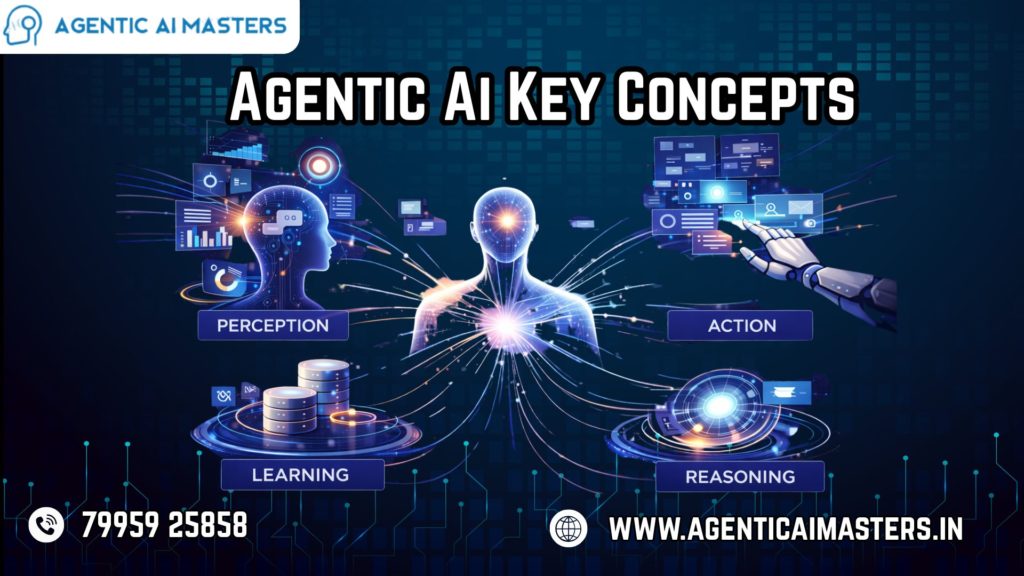
Artificial Intelligence is moving into a new stage of evolution. For many years, most AI systems were built to react—users asked questions, and the system responded with answers. By 2026, this interaction model is no longer sufficient. Organizations, platforms, and learners now expect AI systems to anticipate needs, make decisions independently, and take action without constant prompts. This transformation has led to the rise of Agentic AI.
Agentic AI represents a shift from prompt-based systems to goal-driven intelligence. These systems are designed to understand their environment, determine what actions are required, use tools to execute those actions, and improve based on results. Instead of merely generating outputs, Agentic AI systems take responsibility for outcomes. This capability is why Agentic AI is becoming a core pillar of automation, enterprise platforms, and future-oriented career paths.
This guide explains the ten most essential Agentic AI key concepts in a clear and structured way. Whether you are a student exploring modern AI, a professional preparing to upskill, or a builder creating real-world systems, these concepts will help you build a strong mental framework. We start with the fundamentals—what Agentic AI truly is, how AI agents function, and how perception enables autonomous behavior.

What is Agentic AI?
Agentic AI refers to an advanced form of artificial intelligence that can autonomously make decisions, take actions, and solve problems with a level of independence. These AI systems are designed to mimic human-like reasoning and act based on their own set of goals and rules. Unlike traditional AI systems, which are often limited to predefined tasks and require human intervention for decision-making, Agentic AI operates autonomously to achieve long-term objectives with minimal human oversight.
Top 10 Agentic AI Key Concepts Explained
1. Agentic AI
Agentic AI is not a single model, tool, or framework. It is a system-level approach to building intelligent behavior. At its foundation, Agentic AI refers to systems that can define objectives, plan actions, execute tasks, and evolve over time.
Traditional AI systems are largely reactive. They wait for input and respond based on learned patterns. Even advanced generative models typically operate in a prompt-to-response cycle. Agentic AI goes beyond this limitation by introducing initiative and ownership.
What makes an AI system agentic?
An AI system can be considered agentic when it can:
- Determine next steps without explicit instructions
- Operate across multiple actions and tools
- Adjust behavior based on outcomes and feedback
- Work toward goals rather than isolated tasks
For example, instead of instructing an AI to “write an email,” an agentic system can be assigned a broader objective such as “increase demo bookings this month.” The system then decides how to proceed—researching prospects, sending outreach messages, scheduling follow-ups, and refining its approach based on results.
Why Agentic AI matters in 2026
Agentic AI is gaining importance because modern challenges are:
- Ongoing rather than one-time
- Multi-step instead of single-action
- Focused on outcomes rather than outputs
Organizations are shifting away from rigid automation toward autonomous workflows. As a result, Agentic AI is becoming a foundational concept for the next generation of intelligent systems.
2. Agent
An AI agent is the core building block of any agentic system. An agent can be thought of as an independent decision-making unit within a larger architecture.
At a basic level, an AI agent:
- Observes incoming information
- Determines the appropriate action
- Executes that action
- Evaluates the result
This cycle repeats continuously, allowing the agent to function autonomously within defined limits.
What an AI agent is—and is not
An AI agent is not simply:
- A chatbot
- A static script
- A single API request
Instead, an AI agent is a software entity capable of reasoning about situations and selecting actions dynamically.
Core responsibilities of an AI agent
An AI agent typically handles:
- Decision-making – selecting the best next action
- Execution – performing actions through tools or APIs
- Adaptation – modifying behavior based on feedback
Simple systems may rely on a single agent. More advanced architectures use multiple agents, each responsible for a specific role.
AI agent example
A basic AI agent might:
- Monitor incoming support tickets
- Categorize issues
- Respond to common questions
- Escalate complex cases to human staff
A more advanced agent could:
- Track resolution times
- Detect recurring problems
- Suggest product improvements
- Learn which responses lead to higher satisfaction
This progression—from task execution to decision ownership—is what gives AI agents their power.
3. Perception
Perception is the mechanism through which an AI agent becomes aware of its environment. Without perception, an agent cannot make informed decisions and would operate without awareness.
In Agentic AI, perception extends beyond direct user input. It includes any signal that helps the agent understand current conditions.
What perception includes
An agent’s perception may be derived from:
- User inputs and commands
- API responses
- Database entries
- Logs and system metrics
- Real-time events
- Sensor or operational data
Perception helps answer questions such as:
- What is happening right now?
- What has changed since the last action?
- What limitations or constraints exist?
- What information is missing?
Why perception is essential
Strong perception enables:
- More accurate reasoning
- Context-aware actions
- Fewer errors
- Better adaptability
Weak perception can result in:
- Incorrect assumptions
- Irrelevant or harmful actions
- Repeated mistakes
For instance, a marketing agent that cannot perceive campaign performance metrics may continue ineffective strategies. A financial agent that misses regulatory updates could introduce compliance risks.
Perception vs context
While closely related, perception and context are not the same:
- Perception refers to incoming signals
- Context refers to the relevant subset of information selected from those signals
An agent may perceive large volumes of data, but only a portion becomes useful context for decision-making.
Designing perception in agentic systems
Effective agentic systems:
- Clearly define which data is important
- Filter noise from meaningful signals
- Continuously update environmental awareness
- Prevent overload of the reasoning layer
By 2026, perception design is as critical as choosing the right AI model. Many agentic system failures occur not because the AI cannot reason, but because it lacks the right information at the right time.
How These Concepts Connect
At this point, three foundational ideas are established:
- Agentic AI defines the overall system approach
- Agents serve as autonomous decision-making units
- Perception enables agents to understand their environment
Together, these concepts form the foundation of autonomous intelligence. In the next section, the focus moves beyond perception to explore how agents reason, decide, act, and interact with tools in real-world systems.
4. Reasoning
Reasoning is the thinking engine of an agentic AI system. Once an agent has perceived its environment, reasoning determines what to do next and why. This is the stage where raw information turns into decisions.
In traditional AI systems, decision-making is often rule-based or hard-coded. In Agentic AI, reasoning is dynamic, contextual, and goal-oriented.
What reasoning means in Agentic AI
Reasoning is the process by which an agent:
- Interprets perceived information
- Evaluates options
- Considers constraints and trade-offs
- Chooses the most suitable action
It answers questions such as:
- What is the current goal?
- What options are available?
- What are the risks of each option?
- What should be done first?
Types of reasoning used by agents
Modern agentic systems often combine multiple reasoning styles:
- Reactive reasoning
Immediate responses based on current input. Useful for fast decisions. - Deliberative reasoning
Slower, more thoughtful reasoning that evaluates multiple steps ahead. - Constraint-based reasoning
Decisions made within defined limits such as budget, time, or policy. - Probabilistic reasoning
Choosing actions based on likelihood of success rather than certainty.
In practice, an agent may switch between these modes depending on urgency and complexity.
Reasoning vs intelligence
It is important to note that reasoning is not about “being smart” in a human sense. It is about structured decision-making. A well-designed reasoning loop can outperform a more powerful model that lacks clarity or constraints.
In 2026, strong agentic systems rely less on raw model size and more on clear reasoning structures.
Why reasoning quality matters
Poor reasoning leads to:
- Wrong priorities
- Inefficient workflows
- Repeated failures
Strong reasoning enables:
- Better sequencing of actions
- Reduced errors
- Faster goal achievement
This is why many Agentic AI failures are not model failures, but reasoning design failures.
5. Action
Action is where Agentic AI moves beyond thinking and creates real-world impact. Without action, reasoning remains theoretical.
An action is any step an agent takes to influence its environment.
What counts as an action
Actions can include:
- Calling an API
- Updating a database
- Sending an email or message
- Triggering a workflow
- Executing code
- Creating or modifying files
In other words, actions are how AI decisions change the state of systems.
Why action separates agentic AI from chatbots
Chatbots produce outputs. Agentic AI produces outcomes.
For example:
- A chatbot can suggest a response to a customer.
- An agentic system can send the response, log the ticket, update the CRM, and schedule a follow-up.
This shift from output to outcome is central to Agentic AI.
Action execution challenges
Designing actions is not trivial. Agents must:
- Choose safe and valid actions
- Avoid unintended side effects
- Handle failures gracefully
A well-designed agent:
- Verifies actions before execution
- Confirms results after execution
- Adjusts behavior if actions fail
Action loops
In advanced systems, action is part of a loop:
- Decide
- Act
- Observe results
- Learn and adjust
This loop allows agents to improve over time rather than repeating the same mistakes.
Note:- If you want to learn about Agentic Ai Examples Refer our blog
6. Tool Use
Tool use is what gives Agentic AI real power. Tools allow agents to interact with external systems, access information, and perform tasks beyond text generation.
In 2026, most production-grade agentic systems are tool-centric.
What tools are in Agentic AI
Tools can be:
- APIs (search, payments, analytics)
- Internal services (CRM, ERP, ticketing systems)
- Automation platforms
- Databases
- Cloud services
Each tool extends the agent’s capabilities.
How agents use tools
An agent typically:
- Identifies which tool is needed
- Formats the request
- Sends the request
- Interprets the response
- Decides next steps
This requires tight integration between reasoning and execution.
Tool use vs prompt engineering
Prompt engineering focuses on how you ask questions. Tool use focuses on what the system can do.
In modern agentic systems:
- Prompts guide reasoning
- Tools enable execution
This is why tool design is often more important than prompt wording.
Risks and safeguards
Tool use introduces risk. Agents might:
- Call the wrong API
- Send incorrect data
- Trigger unintended actions
To manage this, systems use:
- Permission layers
- Validation checks
- Human-in-the-loop controls
- Rate limits and policies
Effective tool governance is a core requirement for enterprise adoption.
How Reasoning, Action, and Tool Use Work Together
These three concepts form the operational core of Agentic AI:
- Reasoning decides what should happen
- Action makes it actually happen
- Tool use enables interaction with real systems
If any one of these is weak, the entire system suffers:
- Strong reasoning + weak actions → no impact
- Strong actions + weak reasoning → chaos
- Strong tools + poor governance → risk
Mini Comparison Table
Concept | Role | Why It Matters |
Reasoning | Decision-making | Chooses the right path |
Action | Execution | Creates outcomes |
Tool Use | Capability | Extends reach |
Practical Learning Tips (2026)
If you are learning Agentic AI:
- Start by designing reasoning steps on paper
- Add one tool at a time
- Test actions in safe environments
- Observe failures and refine logic
Avoid the common mistake of adding too many tools too early.
If you want to learn about Agentic Ai Tools Refer our blog
7. Context Engineering
Context engineering is one of the most misunderstood yet most critical concepts in Agentic AI. In 2026, high-performing agentic systems are not defined by larger models, but by how well context is designed, selected, and delivered.
At a simple level, context is the information an agent uses to make decisions. Context engineering is the intentional design of what the agent sees, when it sees it, and why.
Why context engineering matters
Large language models have limits:
- Limited context windows
- Sensitivity to irrelevant information
- Inconsistent outputs with noisy inputs
Context engineering solves these problems by:
- Supplying only relevant information
- Structuring inputs clearly
- Reducing hallucinations and errors
In many real-world systems, improving context quality delivers better results than switching to a larger model.
What makes up context in Agentic AI
Context typically includes:
- Current task or goal
- Agent role and responsibilities
- Recent actions and outcomes
- Relevant historical data
- Constraints (policies, budgets, deadlines)
Not all perceived data should become context. The agent must be guided on what matters now.
Context vs memory
While related, they are different:
- Memory stores information
- Context selects information for immediate reasoning
An agent may have access to thousands of records in memory, but only a handful should be injected into context at any given step.
Common context engineering mistakes
- Sending too much information
- Mixing unrelated data
- Repeating static instructions unnecessarily
- Ignoring task state
These mistakes often lead to confusion, inconsistent reasoning, and wasted computation.
Good context design practices
Effective agentic systems:
- Dynamically assemble context
- Prioritize relevance over completeness
- Refresh context at each step
- Separate instructions from data
In 2026, context engineering is considered a core skill for anyone building or operating agentic systems.
8. Model Context Protocol (MCP)
As Agentic AI systems grew more complex, a major challenge emerged: inconsistency. Different agents handled context differently. Tools were injected ad hoc. Memory was used unevenly. This made systems hard to scale, debug, and govern.
The Model Context Protocol (MCP) addresses this problem.
What MCP is
MCP is a structured approach for standardizing how context is delivered to models and agents. It defines how information such as:
- Instructions
- State
- Memory
- Tools
- Constraints
are packaged and passed to an AI system.
Think of MCP as a contract between the system and the model.
Why MCP is important
Without a protocol:
- Context becomes messy
- Agent behavior becomes unpredictable
- Debugging becomes difficult
- Governance becomes weak
With MCP:
- Context is consistent
- Agent behavior is more reliable
- Systems are easier to scale
- Safety controls are enforceable
MCP in enterprise environments
Enterprises care deeply about:
- Predictability
- Auditability
- Security
- Compliance
MCP supports these needs by:
- Making context explicit
- Logging decisions and inputs
- Enforcing policies at the protocol level
This is why MCP-like approaches are increasingly used in production-grade agentic architectures.
MCP and multi-agent systems
In multi-agent environments, MCP ensures that:
- Agents share context in a structured way
- Responsibilities are clearly defined
- Information flow is controlled
This prevents context leakage and role confusion across agents.
Why MCP is a “quiet revolution”
MCP doesn’t make headlines like new models do. But it quietly enables stable, scalable Agentic AI systems. In many 2026 deployments, MCP-style design is the difference between prototypes and production systems.
9. LangChain
While concepts like context engineering and MCP define how systems should behave, builders still need tools and frameworks to implement them. This is where LangChain plays an important role.
LangChain is a framework designed to help developers build agentic workflows using large language models.
What LangChain is used for
LangChain helps with:
- Tool calling
- Memory management
- Agent reasoning loops
- Multi-step workflows
- Integration with external systems
It acts as a bridge between models and real-world applications.
Why LangChain matters for Agentic AI
Before frameworks like LangChain:
- Agent logic was often ad hoc
- Tool integration was repetitive
- Memory handling was inconsistent
LangChain provides reusable patterns that reduce friction and speed up development.
LangChain and context engineering
LangChain allows developers to:
- Control how context is assembled
- Inject memory selectively
- Manage state across steps
This aligns well with strong context engineering practices.
LangChain in learning vs production
For learners:
- LangChain offers a hands-on way to understand agent loops
- It reduces boilerplate code
For production:
- LangChain provides structure
- But still requires careful governance and testing
It is important to note that LangChain is a tool, not a solution. Poor design decisions can still lead to fragile systems.
When to use LangChain
LangChain is best used when:
- Building multi-step agent workflows
- Integrating multiple tools
- Experimenting with agent behavior
In large enterprise systems, LangChain is often combined with custom architecture rather than used alone.
How Context Engineering, MCP, and LangChain Fit Together
These three concepts work at different levels:
- Context Engineering defines what information matters
- MCP standardizes how that information is delivered
- LangChain provides implementation tools
Together, they enable:
- Reliable agent behavior
- Scalable architectures
- Safer autonomy
Without these layers, agentic systems often become brittle and unpredictable as they grow.
Mini Comparison Table
Concept | Focus | Primary Benefit |
Context Engineering | Information relevance | Better reasoning |
MCP | Standardization | Stability and governance |
LangChain | Implementation | Faster development |
Learning Advice for 2026
If you are serious about Agentic AI:
- Learn context design before chasing new models
- Understand MCP-style thinking even if you don’t implement it formally
- Use frameworks like LangChain as scaffolding, not crutches
Many professionals struggle not because AI is complex, but because system design is overlooked.
If you want to learn about Agentic Ai Architecture Refer our blog
10. AgentFlow
AgentFlow describes the end-to-end lifecycle of how an agentic system operates—continuously and autonomously—across perception, reasoning, action, learning, and improvement. If Agentic AI is the philosophy and agents are the workers, AgentFlow is the operating system.
The typical AgentFlow lifecycle
- Perceive – Observe inputs, signals, and environment state
- Reason – Evaluate goals, constraints, and options
- Plan – Sequence actions and decide priorities
- Act – Execute steps using tools and APIs
- Observe outcomes – Check results and system changes
- Learn & reflect – Update memory and strategies
This loop runs continuously. The system doesn’t “finish”—it improves.
Why AgentFlow matters
- Prevents ad-hoc, brittle behavior
- Enables debugging and observability
- Supports learning over time
- Turns tasks into outcomes
In 2026, mature Agentic AI systems are judged by how clean and resilient their AgentFlow is—not by how clever a single prompt looks.
Comparison Table – Agentic AI Key Concepts
Concept | What It Does | Why It Matters in Production |
Agentic AI | Goal-driven systems | Moves from outputs to outcomes |
Agent | Decision unit | Enables autonomy |
Perception | Environment awareness | Prevents blind actions |
Reasoning | Decision logic | Improves prioritization |
Action | Execution | Creates real-world impact |
Tool Use | System interaction | Extends capabilities |
Context Engineering | Information selection | Reduces errors |
MCP | Context standardization | Improves safety & scale |
LangChain | Implementation framework | Speeds development |
AgentFlow | Lifecycle orchestration | Ensures continuity |
How These Concepts Work Together
Agentic systems succeed when all concepts reinforce each other:
- Perception feeds context
- Context enables reasoning
- Reasoning triggers actions
- Actions use tools
- Outcomes update memory
- Memory shapes future context
Single-agent systems can handle simple goals. Multi-agent systems assign roles (planner, executor, reviewer) and collaborate to solve complex problems—often outperforming monolithic designs.
Real-World Applications of Agentic AI (2026)
Business & Operations
- End-to-end workflow automation
- Autonomous reporting and decision support
- Intelligent IT operations and incident response
Marketing & Growth
- SEO and content planning agents
- Campaign optimization with continuous learning
- Lead generation and follow-ups
Healthcare & Finance
- Care coordination and alerts
- Compliance monitoring and audit trails
- Risk analysis and portfolio optimization
Software Development
- Requirements-to-code pipelines
- Self-testing and code review agents
- Release coordination and rollback planning
These systems don’t just assist—they own outcomes.
Learning Path for Agentic AI (Beginner → Pro)
Beginner
- Understand agents, perception, reasoning
- Build a single-agent tool-calling project
- Focus on clarity over complexity
Intermediate
- Add memory and context engineering
- Introduce multi-step planning
- Use a framework to manage flow
Advanced
- Design multi-agent collaboration
- Apply MCP-style context governance
- Add observability, safety, and cost controls
Future of Agentic AI Concepts
Self-organizing agents
Agents will dynamically form teams, assign roles, and adapt workflows.
Autonomous digital workers
Persistent agents will manage long-running responsibilities across systems.
Agent marketplaces
Reusable agents and tools will be shared, versioned, and composed.
Governance-first autonomy
Protocols, auditability, and human oversight will be standard—not optional.
FAQs - Agentic AI Key Concepts
1. What are the most important Agentic AI concepts to learn first?
Start with agents, perception, reasoning, and action, as they form the core foundation of Agentic AI systems.
2. Is Agentic AI used in real companies today?
Yes, it is widely used in automation, IT operations, finance, marketing, and enterprise workflows.
3. Do I need advanced math or machine learning knowledge?
No, system thinking, APIs, logic, and workflow design are more important than deep mathematics.
4. How is Agentic AI different from automation?
Automation follows fixed rules, while Agentic AI can adapt, plan, and make decisions dynamically.
5. Is Agentic AI a good career path in 2026?
Yes, demand is growing rapidly across industries for agentic AI skills.
6. What is an AI agent in simple terms?
An AI agent is a software entity that can observe, decide, and act toward a goal.
7. How is Agentic AI different from chatbots?
Chatbots respond to prompts, while Agentic AI systems take actions and own outcomes.
8. Can Agentic AI work without human supervision?
It can operate autonomously but usually includes human oversight for safety and control.
9. What role does perception play in Agentic AI?
Perception allows agents to understand their environment and current system state.
10. Why is reasoning important in agentic systems?
Reasoning helps agents evaluate options and choose the best actions to achieve goals.
11. What does action mean in Agentic AI?
Action refers to executing decisions using tools, APIs, or system commands.
12. Why is tool use critical for Agentic AI?
Tools enable agents to interact with real-world systems and produce tangible outcomes.
13. What is context engineering in Agentic AI?
It is the process of selecting and structuring the right information for agent decision-making.
14. How is context different from memory?
Memory stores information, while context selects what is relevant at a given moment.
15. What is Model Context Protocol (MCP)?
MCP standardizes how instructions, memory, and tools are provided to AI systems.
16. Why is MCP important for enterprises?
It improves consistency, safety, scalability, and governance of agentic systems.
17. Is LangChain required to build Agentic AI?
No, but it helps simplify building multi-step agent workflows.
18. Can Agentic AI systems use multiple agents?
Yes, multi-agent systems are common in advanced agentic architectures.
19. What is AgentFlow?
AgentFlow describes the full lifecycle of an agent from perception to learning.
20. How do agents learn over time?
They use feedback loops, memory updates, and outcome evaluation.
21. Are Agentic AI systems expensive to build?
Costs vary, but starting small and scaling gradually helps manage expenses.
22. Can non-technical learners understand Agentic AI concepts?
Yes, the concepts focus more on logic and systems than coding depth.
23. What industries benefit most from Agentic AI?
Healthcare, finance, marketing, IT operations, and software development benefit heavily.
24. Is Agentic AI safe for production use?
Yes, when guardrails, monitoring, and governance are properly implemented.
25. What are common mistakes when building agentic systems?
Poor context design, weak reasoning logic, and lack of safety controls.
26. How is Agentic AI different from Generative AI?
Generative AI produces content, while Agentic AI plans and executes actions.
27. Does Agentic AI replace human jobs?
It automates tasks but mainly augments human roles rather than replacing them.
28. What skills are most valuable for learning Agentic AI?
System design, APIs, logic building, and understanding workflows.
29. Can Agentic AI systems operate across multiple tools?
Yes, they are designed to orchestrate actions across many tools and platforms.
30. What is the future of Agentic AI beyond 2026?
It will move toward self-organizing systems, autonomous digital workers, and governed AI ecosystems.
if you want to learn Agentic AI Course in Hyderabad, Contact Agentic AI Masters