Table of Contents
ToggleAgentic AI Tools
Introduction to Agentic AI Tools
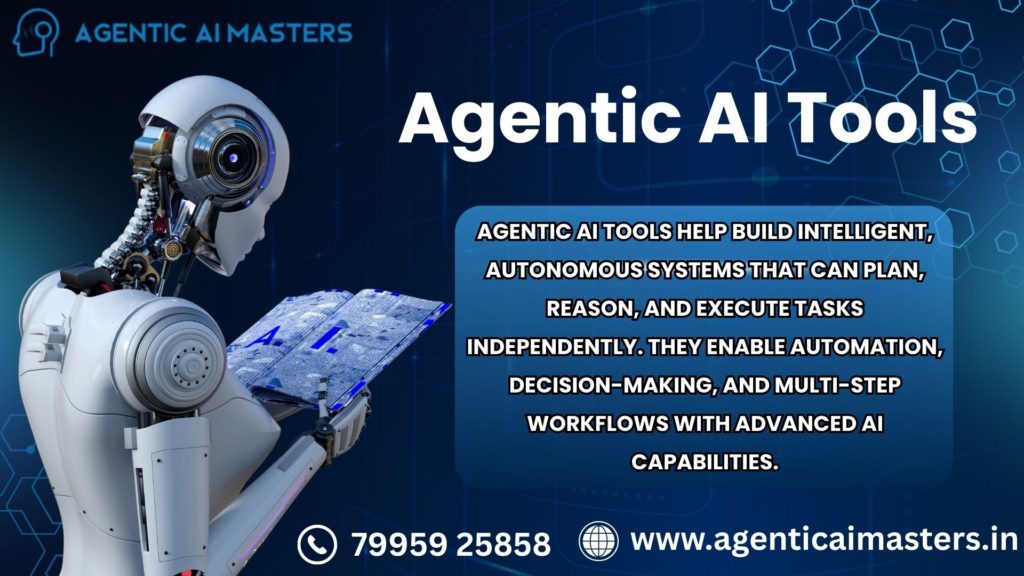
Agentic AI tools represent a major advancement in the field of autonomous intelligent systems. Unlike traditional artificial intelligence that primarily relies on direct prompts, rule-based logic, or predefined workflows, agentic AI systems are designed to operate with autonomy. These tools possess the ability to interpret information, analyze diverse datasets, make independent decisions, execute tasks across digital environments, and adapt dynamically to evolving conditions. This evolution marks a critical shift from static AI outputs to dynamic, action-oriented automation frameworks.
At their core, agentic AI tools function as intelligent agents capable of multi-step reasoning and continuous operational control. These agents do not simply respond to instructions; they assess the context, generate internal plans, validate execution steps, and refine outputs based on real-time feedback. This enables them to manage complex enterprise processes that traditionally required human supervision, such as workflow coordination, advanced analytics, operational monitoring, and cross-system task execution.
The rapid integration of agentic AI tools across industries signals their growing relevance in modern enterprise architecture. Organizations are shifting toward more adaptive and efficient systems where autonomous agents can work alongside human teams to enhance productivity, accelerate decision-making, and reduce operational bottlenecks. As businesses scale, the need for reliable and intelligent automation increases, making agentic AI tools a strategic priority for digital transformation.
This article provides a comprehensive, technical examination of agentic AI tools. It explores their functional design, architectural structure, operational mechanisms, enterprise use cases, integration strategies, and future potential. The analysis is structured to offer clarity for AI engineers, enterprise leaders, technology researchers, and professionals seeking an in-depth understanding free from speculative or exaggerated claims. The focus remains on enabling readers to make informed decisions regarding the deployment, governance, and optimization of agentic AI tools in real-world scenarios.

What Are Agentic AI Tools? A Technical Definition
Agentic AI tools are advanced software systems engineered to operate as autonomous computational agents. These tools are capable of functioning across diverse digital and operational environments, interpreting contextual inputs, formulating actionable plans, and executing tasks to achieve clearly defined objectives. Unlike conventional AI systems, which primarily produce outputs in response to direct instructions or predefined rules, agentic AI tools exhibit self-directed behavior, enabling them to operate independently and make complex decisions without continuous human oversight.
The defining feature of agentic AI tools is their ability to combine reasoning, planning, and execution within a single framework. They are designed not only to perform individual operations but also to sequence multi-step tasks, monitor outcomes, and adjust strategies based on feedback from their environment. This capability allows organizations to deploy agentic AI tools across enterprise functions, from workflow automation to strategic decision support, thereby improving efficiency, scalability, and operational resilience.
Core Characteristics of Agentic AI Tools
- Autonomy: Agentic AI tools can take independent actions based on system inputs and predefined objectives, eliminating the need for constant human supervision.
- Goal-Oriented Reasoning: These tools identify optimal strategies to accomplish specified goals, utilizing reasoning algorithms to select the most effective course of action.
- Adaptive Learning: Agentic AI systems continuously refine internal models through feedback loops, incorporating environmental changes and outcome analysis to improve future performance.
- Dynamic Decision-Making: Capable of handling multi-step operations, agentic AI tools execute complex sequences of tasks requiring logical reasoning and prioritization.
- Contextual Awareness: These tools can interpret a wide range of inputs, including data streams, user preferences, system conditions, and environmental triggers, enabling informed decision-making.
- Interoperability: Agentic AI tools are designed to integrate seamlessly with enterprise databases, APIs, cloud platforms, and other software systems, facilitating cross-functional workflows.
Differences Between Traditional AI and Agentic AI
Feature | Traditional AI | Agentic AI Tools |
Action Approach | Responds to direct prompts | Plans multi-step sequences |
Output vs Execution | Generates outputs | Executes tasks autonomously |
Input Requirement | Requires input at each step | Monitors and adapts without constant input |
Behavior | Reactive | Proactive |
Scope | Task-specific | Supports cross-functional workflows |
These differences highlight why agentic AI tools are particularly suited for enterprise automation, decision support, and dynamic operational environments, where single-step AI solutions may be insufficient.
How Agentic AI Tools Work: Technical Framework & Architecture
Understanding how agentic AI tools function requires a detailed examination of their underlying architecture. While implementations differ across vendors, the fundamental components and operational principles remain largely consistent. The architecture of agentic AI is designed to support autonomous decision-making, dynamic task execution, and adaptive learning across complex environments.
Agentic AI tools rely on a layered and modular structure that integrates reasoning, execution, feedback, and governance. Each component plays a critical role in ensuring the agent can operate independently while maintaining reliability, security, and interoperability.
1. Core Architectural Components
- Foundation Model Layer: The foundation layer comprises large language models (LLMs), multimodal AI models, or domain-specific AI systems. This layer provides the core intelligence, enabling natural language understanding, contextual reasoning, and decision-making across multiple modalities.
- Agent Controller or Execution Engine: The execution engine coordinates task scheduling, manages the sequence of operations, and maintains the current state of the agent. It ensures that the agent executes plans efficiently while adhering to defined constraints.
- Planning Module: The planning module generates actionable strategies using reasoning algorithms, logical decision trees, or graph-based planning models. It enables agents to break complex goals into manageable steps and optimize task execution.
- Memory Subsystem: This subsystem stores contextual information, historical interactions, intermediate results, and user preferences. It allows the agent to reference past events and maintain continuity across multi-step workflows.
- Tooling Interface (Tool Use Framework): The tooling interface enables agents to interact with external systems, APIs, databases, and software applications. Through this interface, the agent can manipulate data, execute functions, and coordinate tasks across heterogeneous environments.
- Feedback and Evaluation Engine: This component monitors task outcomes, identifies deviations or errors, and triggers self-correction mechanisms. Continuous feedback ensures that the agent can learn from past actions and improve future performance.
- Security, Governance, and Guardrail Layer: This layer enforces compliance, risk mitigation, and controlled execution policies. It ensures that agentic AI tools operate within organizational guidelines, data protection regulations, and operational safety standards.
2. Types of Agentic Architectures
- Single-Agent Systems: A single autonomous agent manages and executes a sequence of tasks independently. These systems are suitable for well-defined workflows with minimal external dependencies.
- Multi-Agent Systems (MAS): In multi-agent systems, multiple autonomous agents collaborate or specialize in different domains such as data processing, reporting, analysis, and decision-making. MAS allows for distributed intelligence and enhanced scalability.
- Hierarchical Agentic Systems: Hierarchical architectures involve supervising agents that manage subordinate agents. This structure is ideal for complex workflows requiring oversight, prioritization, and task delegation across multiple levels of operations.
- Hybrid Agentic Environments: Hybrid systems combine autonomous agentic operations with human oversight. Human operators can intervene at critical decision points, ensuring safety and compliance while benefiting from agent-driven efficiency.
If you want to learn about Agentic AI Architecture
Key Capabilities of Agentic AI Tools
Agentic AI tools offer a range of capabilities that distinguish them from conventional AI systems. These capabilities make them particularly suitable for enterprise-scale deployment, where complex workflows, multi-system integration, and adaptive decision-making are required. By combining autonomy with reasoning and domain-specific knowledge, agentic AI tools provide organizations with robust solutions for efficiency, scalability, and intelligent automation.
1. Autonomous Workflow Execution
Agentic AI tools can independently perform both repetitive and complex workflows across diverse systems. Examples include:
- Automating customer support processes such as ticket routing, query resolution, and response generation.
- Streamlining financial operations including data reconciliation, reporting, and transaction validation.
- Managing content workflows such as content creation, review, and publication.
- Overseeing internal business processes like HR onboarding, inventory management, and operational monitoring.
Autonomous workflow execution reduces human intervention, minimizes errors, and improves process efficiency.
2. Reasoning and Planning
Agentic AI tools utilize advanced reasoning models to structure tasks logically and determine optimal action sequences. Key approaches include:
- Chain-of-thought reasoning: Stepwise problem-solving to derive accurate conclusions.
- Tree-of-thought reasoning: Exploring multiple decision branches to select the most effective path.
- Graph-based reasoning: Mapping relationships between entities, actions, and outcomes to optimize planning.
This capability allows agents to handle multi-step tasks that require foresight, logical sequencing, and contingency planning.
3. Multi-Tool Coordination
Modern agentic AI systems are capable of integrating and coordinating multiple tools, APIs, or plugins in a cohesive workflow. This enables:
- End-to-end automation of complex tasks.
- Interaction between diverse enterprise systems such as CRMs, ERPs, and cloud platforms.
- Seamless execution of multi-step operations that require data transfer, processing, and reporting across platforms.
Multi-tool coordination ensures operational efficiency and reduces the dependency on human intervention for system integration.
4. Real-Time Adaptation
Agentic AI tools continuously monitor the outcomes of their actions and adapt strategies dynamically in response to unexpected events or changing conditions. Examples include:
- Adjusting automated customer responses based on live feedback.
- Modifying operational plans when system errors or data discrepancies are detected.
- Reprioritizing tasks in real-time to optimize performance and minimize delays.
Real-time adaptation is critical for applications in dynamic environments where static automation is insufficient.
5. Domain-Specific Intelligence
Through fine-tuning, knowledge embedding, and specialized training, agentic AI tools can acquire deep expertise in specific industries or functional domains, such as:
- Finance: Risk assessment, automated reconciliation, predictive analytics.
- E-commerce: Inventory optimization, personalized recommendations, customer journey analysis.
- Insurance: Claims processing, policy review, fraud detection.
- Marketing: Campaign automation, segmentation, content optimization.
- Operations and Research: Process monitoring, decision support, analytics reporting.
Domain-specific intelligence allows organizations to deploy agents with precise operational knowledge, increasing reliability and effectiveness.
Enterprise Applications of Agentic AI Tools (Technical Use Cases)
Agentic AI tools are increasingly being integrated into enterprise workflows to improve operational efficiency, decision-making, and business scalability. By leveraging autonomous reasoning, adaptive learning, and multi-system coordination, these tools allow organizations to execute complex tasks with minimal human intervention. The following sections highlight key enterprise applications of agentic AI tools across various domains.
1. Customer Support Automation
Agentic AI tools can enhance customer support operations by automating repetitive and complex tasks:
- Ticket Classification and Routing: Automatically categorize incoming tickets and route them to the appropriate support team.
- Autonomous Response Generation: Generate accurate, context-aware responses without human intervention.
- Multi-Channel Communication Handling: Manage customer interactions across email, chat, social media, and messaging platforms.
- Continuous Learning: Adapt response strategies based on customer feedback and historical interactions, improving accuracy over time.
2. Sales and Lead Management
In sales operations, agentic AI tools provide intelligent support to enhance lead conversion and streamline workflows:
- Prospect Qualification: Analyze CRM data to prioritize high-potential leads.
- Automated Sales Workflows: Manage follow-up sequences, scheduling, and reminders autonomously.
- Script Generation for Sales Calls: Create optimized scripts for engagement based on customer profiles and historical data.
- Real-Time Objection Handling: Provide recommendations or automated responses to overcome common sales objections.
3. Marketing Automation
Agentic AI tools transform marketing operations by enabling precise and adaptive campaign execution:
- Content Generation and Scheduling: Automate creation and publication of content across multiple channels.
- Keyword Research and SEO Analysis: Perform comprehensive SEO audits and identify high-value keywords for campaigns.
- Customer Segmentation and Journey Design: Automatically segment audiences and design personalized engagement flows.
- Personalization of Campaigns: Deliver tailored messaging based on user behavior, preferences, and historical interactions.
4. Enterprise Data Analysis
Agentic AI tools enable faster and more accurate enterprise analytics:
- Automated Reporting Dashboards: Generate real-time dashboards for monitoring key performance indicators.
- Natural Language Data Queries: Allow non-technical users to query complex datasets using plain language.
- Predictive Analytics: Analyze historical trends and generate forecasts for financial, operational, and strategic decision-making.
5. IT and DevOps Operations
In IT and DevOps, agentic AI tools support operational stability and efficiency:
- Issue Detection and Automated Remediation: Identify system errors or failures and apply corrective actions autonomously.
- Log Analysis and Anomaly Detection: Continuously monitor logs and detect unusual patterns that may indicate system issues.
- Automated Documentation and Deployment Workflows: Manage code deployments, version control, and documentation generation without manual intervention.
6. Product Development and Research
Agentic AI tools enhance research and product development processes by providing intelligent automation:
- Requirement Generation and PRD Documentation: Automate the creation of product requirement documents and technical specifications.
- Automated Software Testing: Perform test case generation, execution, and reporting with minimal human oversight.
- Code Generation, Refactoring, and Debugging: Assist developers by producing code snippets, optimizing existing code, and identifying bugs.
Leading Agentic AI Tools in 2026
The adoption of agentic AI tools has accelerated across enterprises due to their ability to automate complex workflows, enhance productivity, and provide adaptive decision-making. Several platforms have emerged as leaders in this space, each with unique capabilities tailored for specific enterprise functions. This section provides a technical overview of the most prominent agentic AI tools in 2026.
1. Moveworks
Moveworks is a platform for enterprise automation, primarily focused on autonomous IT support. It leverages AI to classify support tickets, provide instant resolutions, and integrate with internal enterprise systems, reducing response times and operational overhead.
2. Microsoft Copilot Agents
Integrated within the Microsoft 365 ecosystem, Copilot Agents assist with multi-step productivity tasks. They enable automation of document creation, spreadsheet analysis, meeting summarization, and workflow orchestration, making enterprise teams more efficient.
3. OpenAI Operator Framework
The OpenAI Operator Framework allows developers to create API-driven agentic workflows using high-performance AI models. Its modular design enables seamless integration with external tools, supporting multi-step reasoning and adaptive task execution.
4. Aisera
Aisera focuses on self-service automation across IT and customer support functions. Its AI agents automate ticketing, knowledge base searches, and routine queries, while continuously learning from interactions to improve response accuracy.
5. CrewAI
CrewAI is a multi-agent framework that facilitates coordination between specialized agents. It allows enterprises to distribute tasks across multiple autonomous agents, each handling domain-specific workflows to enhance efficiency and scalability.
6. Adept
Adept develops task automation agents with advanced reasoning capabilities. These agents can execute complex operations by interpreting structured and unstructured data, making them suitable for research, analytics, and operational workflows.
7. Beam
Beam provides automation pipelines and modular AI agent workflows, enabling enterprises to create end-to-end task sequences. Its modular design allows agents to utilize multiple tools and APIs cohesively for real-world business operations.
8. UiPath
UiPath integrates robotic process automation (RPA) with generative AI capabilities. Its agentic AI tools support repetitive task automation, workflow orchestration, and enhanced data processing, bridging the gap between traditional RPA and autonomous AI.
9. Orby
Orby is an AI agent designed for operational workflows and enterprise productivity. It automates business processes, supports decision-making, and provides insights for operational optimization across departments.
10. Kore.ai
Kore.ai is a conversational and autonomous workflow automation platform. It enables the creation of multi-channel virtual assistants and autonomous agents capable of managing tasks, customer queries, and enterprise interactions efficiently.
11. Anthropic Claude Agents
Anthropic Claude Agents offer safety-focused and explainable agentic reasoning tools. They emphasize interpretability, controlled behavior, and compliance, making them suitable for high-risk and regulated enterprise environments.
Technical Criteria for Selecting Agentic AI Tools
Selecting the most suitable agentic AI tool for enterprise deployment requires careful consideration of multiple technical factors. The right tool must align with operational goals, system requirements, and regulatory standards while delivering reliable autonomy and scalability. Below are the key criteria to evaluate when assessing agentic AI tools.
1. Reasoning and Planning Capabilities
The core strength of an agentic AI tool lies in its ability to reason, plan, and execute tasks efficiently. When evaluating tools, consider:
- Chain-of-Thought Reasoning: Ability to process sequential logic and perform stepwise problem-solving.
- Structured Reasoning: Capability to handle decision trees, graphs, or dependency models for complex operations.
- Dynamic Planning Algorithms: Support for generating adaptable action plans that respond to real-time environmental or operational changes.
Robust reasoning and planning ensure that the agent can handle multi-step workflows, optimize outcomes, and reduce human oversight.
2. Ease of Use and Developer Control
An effective agentic AI tool should provide flexible deployment options and developer-friendly controls, including:
- Configuration Flexibility: Ability to adjust parameters, set objectives, and define task boundaries.
- Code-Level Integration: Support for scripting, SDKs, or APIs to integrate with custom workflows.
- Deployment Complexity: Evaluate whether the tool can be easily deployed in cloud, on-premise, or hybrid environments without extensive infrastructure modifications.
Ease of use ensures faster adoption and reduces operational friction during implementation.
3. Integration and Compatibility
Agentic AI tools must be interoperable with existing enterprise systems to maximize their utility:
- API Frameworks: Availability of standardized interfaces for communication with internal and third-party systems.
- Cloud Support: Compatibility with cloud providers such as AWS, Azure, or Google Cloud.
- Database Access Layers: Ability to connect with SQL/NoSQL databases, data lakes, and enterprise data warehouses.
- Enterprise SaaS Compatibility: Integration with CRM, ERP, HRMS, and other enterprise platforms.
Integration capability ensures seamless coordination across multiple tools, applications, and data sources.
4. Transparency and Explainability
Given the autonomous nature of agentic AI, visibility into decision-making processes is essential:
- Traceable Decision-Making Logs: Maintain detailed records of each action performed by the agent.
- Reasoning Traces: Capture the rationale behind decisions for auditing and analysis.
- Auditability: Ensure compliance with internal governance and regulatory requirements.
Transparency and explainability help organizations maintain trust, mitigate risk, and satisfy regulatory obligations.
5. Security and Compliance
Security and compliance are critical when deploying agentic AI tools in enterprise environments:
- Data Encryption: Protect sensitive data in transit and at rest.
- Access Control: Restrict agent privileges and maintain role-based access management.
- Guardrail Configurations: Implement operational boundaries to prevent unintended actions.
- Protocol Compliance Standards: Ensure adherence to GDPR, HIPAA, SOC 2, or other relevant regulatory frameworks.
A secure and compliant agentic AI tool reduces operational risk while supporting safe autonomous decision-making.
Challenges and Limitations of Agentic AI Tools
While agentic AI tools offer advanced automation and intelligent decision-making, they are not without limitations. Understanding these constraints is critical for enterprises to deploy these systems effectively and safely.
1. Limited Reliability in Ambiguous Environments
Agentic AI tools may struggle in poorly defined, ambiguous, or rapidly changing environments. When input data is incomplete, inconsistent, or noisy, the agent’s autonomous decisions can produce suboptimal or unintended outcomes.
2. Dependency on Underlying Model Quality
The performance of agentic AI tools is closely tied to the quality of their foundational AI models. Large language models or specialized reasoning engines must be robust, up-to-date, and domain-relevant. Any deficiencies in model training, data coverage, or accuracy can directly impact the agent’s reliability.
3. Risk of Unexpected Actions
Without adequate operational guardrails, agentic AI agents may take unintended actions. This is particularly critical in high-stakes domains such as finance, healthcare, or legal operations, where errors can have significant consequences.
4. High Need for Monitoring Frameworks
Autonomous operation necessitates continuous monitoring and oversight frameworks. Organizations must implement real-time tracking, anomaly detection, and logging to ensure agents behave as intended and interventions can occur promptly.
5. Challenges in Auditability and Interpretation
Complex autonomous reasoning can make audit and interpretability difficult. Tracing the rationale behind multi-step decisions or multi-agent interactions requires sophisticated logging and explanation mechanisms to meet compliance and governance standards.
6. Integration Overhead for Legacy Systems
Deploying agentic AI tools often involves integration challenges with existing legacy systems. Data formats, API compatibility, and workflow alignment must be carefully managed to prevent disruption and ensure smooth operations.
7. Requirement of Advanced Governance Protocols
Enterprises must establish robust governance frameworks to manage risk, compliance, and ethical considerations. This includes access control, operational boundaries, decision auditing, and continuous evaluation of agentic AI behavior.
Future of Agentic AI Tools in Enterprises
Agentic AI tools are expected to play a central role in future digital transformation initiatives, driven by advances in AI technology, enterprise adoption, and autonomous workflow frameworks. Their evolution will influence not only operational efficiency but also strategic decision-making and enterprise architecture. Key trends shaping the future of agentic AI tools include:
1. More Powerful Multimodal Agents
Future agentic AI systems will have the capability to process and interpret multiple types of data simultaneously, including text, images, video, and sensor data. This multimodal intelligence will allow agents to:
- Gain a richer contextual understanding of operational environments.
- Improve the accuracy and relevance of autonomous decisions.
- Enable seamless integration of diverse information streams for complex task execution.
2. Autonomous Enterprise Resource Planning (ERP) Systems
Agentic AI tools will increasingly integrate directly into ERP platforms to automate core business operations:
- Finance workflows, including reporting, reconciliation, and forecasting.
- Supply chain management, such as inventory tracking, order fulfillment, and vendor coordination.
- Human resources functions, including onboarding, payroll, and performance management.
- Procurement and vendor management processes, enabling automated approvals and compliance checks.
This level of integration reduces manual intervention and enables real-time operational optimization.
3. AI-Native Organizations
Organizations are likely to evolve into AI-native enterprises, where agentic AI tools serve as active contributors rather than passive assistants:
- Agents will execute operational tasks across departments autonomously.
- Human employees will focus on supervision, strategy, and exception management.
- Enterprise processes will become increasingly adaptive, intelligent, and scalable.
4. Hybrid Human-Agent Collaboration Frameworks
Future enterprise models will emphasize collaborative workflows where humans and agents work in tandem:
- Human judgment will guide complex decision-making and ethical considerations.
- Agentic AI will provide data-driven recommendations, automated execution, and continuous learning.
- Hybrid frameworks will maximize efficiency while ensuring control, compliance, and reliability.
5. Expansion into Safety-Critical Domains
Advances in governance, explainability, and operational guardrails will enable agentic AI tools to operate safely in regulated and high-risk industries:
- Healthcare: Autonomous scheduling, diagnostics support, and patient workflow optimization.
- Finance: Risk assessment, compliance monitoring, and fraud detection.
- Industrial Automation: Predictive maintenance, process monitoring, and real-time operational control.
FAQs - Agentic AI Tools
1. What are agentic AI tools?
Agentic AI tools are autonomous systems capable of planning actions, executing multi-step tasks, and adapting to real-time conditions without continuous human oversight.
2. How do agentic AI tools differ from traditional AI?
Traditional AI provides single-step outputs, whereas agentic AI tools perform multi-step reasoning, tool use, and autonomous task completion across systems.
3. What makes an AI system agentic?
Autonomy, goal-oriented reasoning, adaptive learning, contextual awareness, and the ability to act within an environment define agentic behaviour.
4. What are the core components of agentic AI tools?
Typical components include a foundation model, planning module, memory subsystem, tool-use interface, execution engine, and governance safeguards.
5. Why are agentic AI tools important for enterprises?
They increase operational efficiency, reduce manual workload, optimize workflows, and support intelligent decision-making across business functions.
6. How do agentic AI tools plan tasks?
They use reasoning algorithms such as chain-of-thought, tree-of-thought, and graph-based planning to break tasks into logical steps.
7. What is the role of memory in agentic AI tools?
Memory stores context, historical states, user preferences, and intermediate outputs to support continuity and long-term autonomy.
8. Can agentic AI tools integrate with external systems?
Yes. They integrate using APIs, function calling, databases, cloud services, and enterprise software ecosystems.
9. What level of autonomy can agentic AI tools achieve?
Depending on configuration, they can operate semi-autonomously with human approvals or fully autonomously for execution-critical workflows.
10. How do agentic AI tools ensure decision accuracy?
Through continuous feedback loops, self-correction mechanisms, model fine-tuning, and automated evaluation engines.
11. Are agentic AI tools safe?
They are safe when guardrails, access limits, monitoring frameworks, and audit trails are implemented properly.
12. What are the risks associated with agentic AI tools?
Risks include unintended actions, integration errors, data exposure, bias, and challenges in auditing autonomous decisions.
13. How can enterprises govern agentic AI tools?
Through governance models involving policy-based controls, compliance checks, explainability audits, and user permission systems.
14. Do agentic AI tools comply with data privacy laws?
Most enterprise platforms offer compliance with GDPR, HIPAA, SOC 2, and other standards, but proper configuration is essential.
15. Are agentic AI decisions explainable?
Yes, modern frameworks include reasoning logs, traceable output histories, and explainable AI modules to improve transparency.
16. Where are agentic AI tools most commonly used?
Customer support, marketing automation, sales operations, finance, DevOps, data analysis, logistics, and product development.
17. Can agentic AI tools automate customer support?
Yes. They classify tickets, draft responses, provide solutions, escalate issues, and learn from repeated patterns.
18. How do agentic AI tools support sales teams?
They qualify leads, generate sequences, forecast opportunities, and automate follow-ups in CRM systems.
19. Can agentic AI improve marketing workflows?
They automate content creation, keyword research, analytics, segmentation, scheduling, and personalization.
20. Do agentic AI tools help in product development?
They generate technical documentation, write code, test software, and create iterative development plans.
21. Can small businesses use agentic AI tools?
Yes. Many platforms offer affordable, scalable solutions without requiring advanced technical expertise.
22. How easy is it to deploy agentic AI tools?
Deployment ranges from no-code platforms to fully customizable frameworks depending on enterprise needs and technical maturity.
23. Do agentic AI tools require cloud infrastructure?
Most operate in the cloud, but hybrid and on-premise deployments are available for security-sensitive industries.
24. Can agentic AI tools work with legacy enterprise systems?
Yes, though integration may require middleware, API wrappers, or custom connectors for older technologies.
25. How scalable are agentic AI tools?
They scale based on workload demands, from executing simple workflows to coordinating multi-agent systems across enterprises.
26. What is the biggest limitation of agentic AI tools today?
Ensuring predictable and safe behaviour in complex or ambiguous environments remains the most significant challenge.
27. Why do agentic AI systems need human oversight?
Oversight ensures ethical decision-making, compliance, exception management, and safety during autonomous task execution.
28. Do agentic AI tools struggle with incomplete or unclear instructions?
Yes. Poorly defined goals can lead to inaccurate planning or unintended actions, so clear objectives are essential.
29. Will agentic AI tools replace employees?
They are designed to augment human capabilities, automate repetitive tasks, and allow employees to focus on strategic or creative work.
30. What does the future hold for agentic AI tools?
Future agents will be multimodal, fully autonomous within enterprise ecosystems, deeply embedded in ERP systems, and capable of collaborating seamlessly with humans.
if you want to learn Agentic AI Course in Hyderabad, Contact Agentic AI Masters