Table of Contents
ToggleAgentic AI vs Generative AI
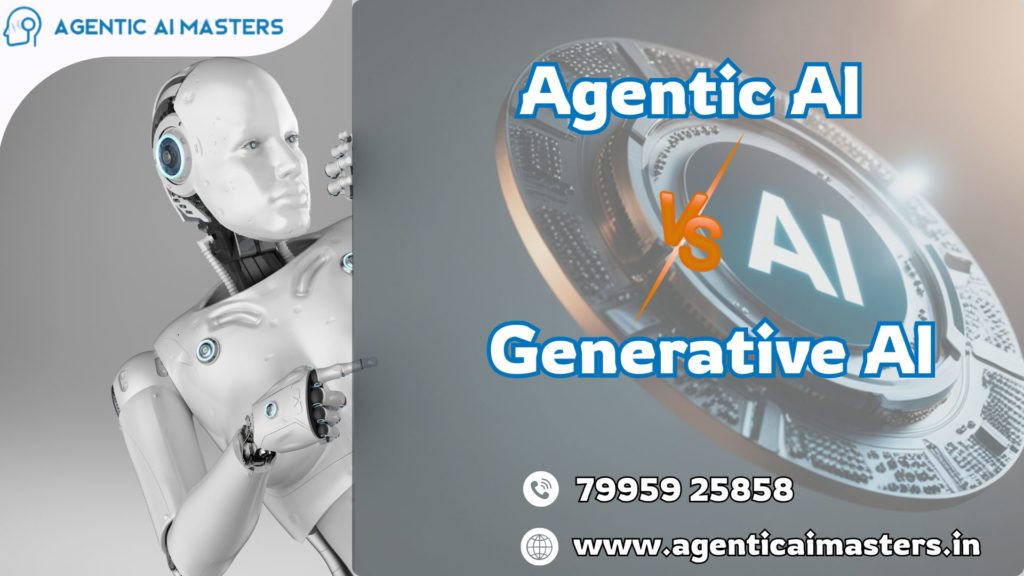
Artificial Intelligence has evolved rapidly over the last few years. Early AI systems focused on automation through fixed rules, while recent breakthroughs in generative AI enabled machines to create text, images, code, and media on demand. However, as we move into 2026, content generation alone is no longer sufficient. Organizations now expect AI systems to think, decide, act, and improve continuously. This shift marks the rise of Agentic AI, where systems move beyond producing outputs and begin owning outcomes.
The distinction between Agentic AI and Generative AI is critical today because they solve fundamentally different problems. Generative AI excels at creativity, ideation, and assisting humans with content and analysis. Agentic AI, on the other hand, focuses on autonomy, enabling AI systems to pursue goals, coordinate multiple steps, interact with tools, and adapt based on feedback. Confusing the two often leads to poor technology decisions, unrealistic expectations, and failed implementations—especially in enterprise environments.
For business leaders, understanding this difference helps determine whether a use case needs creative augmentation or end-to-end automation. For developers and builders, it clarifies how to design systems that move from simple prompt-response workflows to goal-driven architectures. For students and professionals, it shapes learning paths by highlighting whether to focus on prompt engineering, agent orchestration, system design, or AI governance.
This guide is designed to help you build a clear mental model of both approaches. You will understand how Generative AI works, how Agentic AI systems operate, where each fits in real-world applications, and when to use one—or both together. By the end, you will be equipped to make informed decisions about AI tools, architectures, and career skills in a future increasingly shaped by autonomous intelligence.
Note:- If you want to learn about Agentic Ai vs Ai Agents Refer our blog

What is Agentic AI?
How Generative AI Works
Generative AI is designed to create new content based on patterns learned from large volumes of data. At its core, it operates in a simple loop: prompt → prediction → output. When a user provides a prompt, the model predicts the most likely next words, pixels, or code tokens based on prior training. It does not “understand” meaning like a human; instead, it statistically predicts what should come next. Each response is generated in the moment, based largely on the prompt and a limited context window.
Key Characteristics of Generative AI
Generative AI systems share several defining traits:
- Pattern recognition and replication: They learn structures, styles, and relationships from data and reproduce them in new outputs.
- Prompt dependency: The quality of output heavily depends on how clearly and accurately the prompt is written.
- Creative output focus: These systems excel at generating text, images, audio, video, and code that appear original and human-like.
- Single-turn or limited context interactions: Most generative models respond once per prompt and have limited memory beyond the current session.
Common Generative AI Use Cases
Generative AI is widely used across industries for tasks that benefit from creativity and speed, such as:
- Chatbots and AI assistants for answering questions and drafting responses.
- Image and video generation tools for design, marketing, and media creation.
- Code and content generation platforms that assist developers, writers, and marketers.
In short, generative AI is ideal when the goal is to produce content quickly, not to manage workflows or make autonomous decisions.
What Is Agentic AI?
How Agentic AI Works
Agentic AI refers to AI systems designed to operate with goals, not just prompts. Instead of responding once and stopping, Agentic AI follows a continuous perceive → plan → act → learn loop.
- Perceive: The system observes inputs from users, databases, APIs, logs, or real-time events.
- Plan: It reasons about the current situation, evaluates options, and decides the best next steps toward a goal.
- Act: It executes actions using tools, APIs, workflows, or other systems.
- Learn: It evaluates outcomes, stores relevant memory, and improves future decisions.
This loop runs continuously, enabling ongoing decision-making, adaptation, and long-term task ownership rather than one-time responses.
Key Components of Agentic AI
Agentic AI systems are built using several core components that work together:
- Autonomy and initiative: The system decides what to do next without waiting for constant human prompts.
- Short-term and long-term memory: It remembers recent context and retains historical knowledge to improve decisions over time.
- Tool and API integration: Agentic AI can call external tools, software systems, and services to perform real actions.
- Learning from outcomes: Feedback loops allow the system to refine strategies based on success or failure.
Together, these components enable outcome-driven intelligence rather than simple content generation.
Agentic AI vs AI Agents
An AI agent is usually a single task-focused unit that performs a defined function. Agentic AI, however, is a system of agents coordinated through orchestration, shared memory, and planning logic.
The key difference lies in scale and intent:
- Single agents execute tasks.
- Agentic systems manage goals, coordinate multiple agents, and adapt strategies over time.
This orchestration layer is what transforms isolated agents into truly autonomous systems.
Agentic AI vs Generative AI – Core Differences
Purpose
The primary difference between Generative AI and Agentic AI lies in intent.
- Generative AI is designed for content creation. Its goal is to generate text, images, code, or media based on a prompt.
- Agentic AI is designed for goal achievement. It focuses on completing objectives, managing workflows, and delivering outcomes over time.
In short, one creates outputs; the other owns results.
Autonomy and Decision-Making
Generative AI systems are prompt-dependent. They act only when instructed and stop once a response is generated.
Agentic AI systems operate with autonomous initiative. They decide what to do next, when to act, and how to adapt—without constant human input.
Workflow and Functionality
Generative AI typically works in single-shot interactions. Each prompt produces a response, and the workflow ends there.
Agentic AI follows multi-step execution, breaking goals into tasks, sequencing actions, and adjusting plans based on outcomes.
Context and Memory
Generative AI relies on limited context windows and usually forgets information after a session ends.
Agentic AI uses short-term and long-term memory, allowing it to retain context, learn from history, and improve decisions over time.
Ability to Act
Generative AI mainly produces outputs such as text or images.
Agentic AI can take real-world actions by invoking tools, APIs, workflows, and external systems.
Comparison Table: Agentic AI vs Generative AI
Aspect | Generative AI | Agentic AI |
Primary Purpose | Content creation | Goal achievement |
Autonomy | Prompt-driven | Self-directed |
Decision-Making | Reactive | Proactive and adaptive |
Workflow | Single-step responses | Multi-step planning and execution |
Memory | Limited or session-based | Short-term and long-term |
Ability to Act | Generates outputs only | Executes actions via tools/APIs |
Learning | No outcome ownership | Learns from results and feedback |
Best Use Cases | Writing, design, coding help | Automation, orchestration, operations |
This distinction explains why Generative AI powers creativity, while Agentic AI powers autonomy—and why both play very different roles in modern AI systems.
Use Cases – Where Each Approach Excels
Generative AI Use Cases
Generative AI is best suited for scenarios where the primary goal is creating or transforming information quickly. It excels when human creativity, speed, and assistance are required rather than independent decision-making.
- Content and copy generation: Writing blogs, ads, emails, product descriptions, and social media posts at scale.
- Code generation and assistance: Helping developers write, refactor, explain, or debug code snippets.
- Data summarization: Converting long documents, reports, or conversations into clear and concise summaries.
- Conversational customer support: Powering chatbots that answer FAQs, guide users, and provide scripted assistance.
These use cases benefit from generative AI’s ability to produce high-quality outputs on demand, with humans remaining in control.
Agentic AI Use Cases
Agentic AI is designed for ongoing operations and outcome ownership, where systems must act, adapt, and coordinate across multiple steps and tools.
- Customer service automation: Managing tickets end to end, resolving issues, escalating intelligently, and learning from outcomes.
- Healthcare workflow coordination: Orchestrating patient data, scheduling, treatment steps, and follow-ups across systems.
- Automated workflow management: Running business processes such as onboarding, approvals, and cross-team coordination without manual intervention.
- Financial risk monitoring and compliance: Continuously detecting anomalies, tracking regulations, and generating audit-ready actions.
- IT operations and incident response: Monitoring systems, diagnosing issues, triggering fixes, and coordinating recovery in real time.
In summary, Generative AI creates, while Agentic AI operates—each excelling in very different but complementary roles.
Note:- If you want to learn about Agentic Ai Use Cases Refer our blog
Limitations, Risks, and Challenges
Generative AI Limitations
Generative AI systems are powerful for content creation, but they come with clear constraints that limit their use in critical or autonomous scenarios.
- Hallucinations and accuracy issues: Generative AI can produce responses that sound confident but are factually incorrect, especially when prompts lack clarity or data is missing.
- Context window constraints: These systems can only consider a limited amount of information at once, making it difficult to maintain long-term context across extended tasks.
- No verification or action capability: Generative AI generates outputs but cannot verify facts, execute actions, or take responsibility for real-world outcomes without external systems.
Because of these limitations, generative AI works best with strong human oversight.
Agentic AI Risks
Agentic AI introduces autonomy, which increases both capability and risk if not designed carefully.
- Autonomous error propagation: When an agent makes a wrong decision, that error can cascade across multiple steps or systems.
- Goal misalignment: Poorly defined goals can cause agents to optimize the wrong outcomes, leading to unintended behavior.
- Security and governance challenges: Autonomous agents interacting with tools and APIs increase the attack surface and require strict access controls.
- Debugging and observability complexity: Multi-step, multi-agent systems are harder to trace, monitor, and explain compared to single-response models.
These risks make governance, monitoring, and human-in-the-loop design essential for safe agentic AI deployment.
Note:- If you want to learn about Agentic Ai Examples Refer our blog
Choosing Between Generative AI and Agentic AI
When to Use Generative AI
Generative AI is the right choice when your primary goal is to assist humans rather than replace workflows. It works best in scenarios where creativity, speed, and flexibility matter more than autonomy.
- Creative augmentation: Ideal for writing content, designing visuals, brainstorming ideas, or generating code drafts where humans make final decisions.
- Human-in-the-loop workflows: Best when outputs must be reviewed, edited, or approved, such as marketing copy, reports, or customer replies.
- Cost-conscious experimentation: Generative AI tools are easier and cheaper to deploy, making them suitable for pilots, learning, and early-stage innovation.
Generative AI enhances productivity but does not own outcomes.
When to Use Agentic AI
Agentic AI is suitable when systems need to operate independently and deliver results without constant human input.
- Process automation at scale: Useful for workflows that span multiple steps, tools, and systems, such as IT operations or finance processes.
- 24/7 autonomous operations: Ideal when decisions and actions must continue beyond human working hours.
- Multi-system orchestration: Works best when coordination across APIs, databases, and platforms is required.
- Outcome-driven business goals: Agentic AI focuses on achieving objectives, not just producing outputs.
Hybrid Approach – The Practical Strategy
Most real-world systems combine both approaches. Generative AI handles creativity and language, while agentic AI orchestrates actions, tools, feedback loops, and human escalation when needed. This hybrid model delivers flexibility with control.
Learning Path – What Should You Learn First?
For Students
If you are a student or beginner, the goal is to build a strong foundation without getting overwhelmed by advanced systems too early.
- AI fundamentals: Start with basic concepts such as how AI works, what machine learning is, and how large language models generate responses. This helps you understand what AI can and cannot do.
- Prompting and agent basics: Learn how prompts influence AI outputs and how simple AI agents work. Focus on task-based agents, basic decision logic, and tool usage before moving to full agentic systems.
This stage is about clarity and confidence, not complexity.
For Professionals
For working professionals, the focus shifts from understanding AI to applying it in real systems.
- APIs and automation: Learn how to connect AI models with external systems using APIs, webhooks, and automation tools. This is where AI becomes useful in daily workflows.
- Agent workflows and orchestration: Understand how to design multi-step workflows, coordinate tasks, and manage decision logic. This enables you to build systems that go beyond single AI responses.
For Enterprises
Enterprises must focus on scale, safety, and reliability.
- Governance and observability: Learn how to monitor AI behavior, log decisions, and ensure accountability.
- Cost and risk management: Understand infrastructure costs, security risks, and compliance requirements before deploying agentic systems in production.
This layered learning path ensures sustainable and responsible AI adoption.
Agentic AI vs Generative AI in Enterprise Software
In enterprise software, the difference between Agentic AI and Generative AI becomes very practical. Both are valuable, but they solve problems at very different levels.
Software Testing
Generative AI is useful in testing for test case generation, test data creation, and bug explanations. It helps testers work faster by producing scripts or summaries on demand. However, it still depends on human prompts and manual execution.
Agentic AI goes further by owning the testing workflow. An agentic system can plan test strategies, execute tests automatically, analyze failures, rerun tests after fixes, and adapt coverage over time. This makes it suitable for continuous, autonomous testing environments.
DevOps and QA Automation
In DevOps, Generative AI assists with log analysis, configuration suggestions, and documentation. It improves productivity but does not manage pipelines independently.
Agentic AI can monitor pipelines, detect failures, trigger rollbacks, allocate resources, and optimize deployments without waiting for human input. This enables self-healing DevOps and proactive QA automation.
Business Process Orchestration
Generative AI helps by creating reports, drafting emails, or summarizing workflows. It supports humans but does not control processes.
Agentic AI orchestrates end-to-end business processes. It coordinates multiple systems, makes decisions across departments, tracks outcomes, and adjusts workflows dynamically—turning enterprise software into an autonomous operating layer rather than a passive tool.
This is why enterprises increasingly combine both, using Generative AI for intelligence and Agentic AI for execution.
Future of AI – Convergence of Generative and Agentic Systems
The future of AI is not about choosing between Generative AI and Agentic AI—it is about their convergence. As we move into 2026 and beyond, AI systems are evolving from isolated capabilities into integrated, intelligent ecosystems that both think and act.
Emerging Trends
Embedded Intelligence
AI will no longer exist as a separate tool. Generative capabilities will be embedded inside agentic systems, enabling software to understand context, generate insights, and take action seamlessly within workflows.
Specialized Agents and Agent Ecosystems
Instead of one large AI doing everything, organizations will deploy networks of specialized agents—each responsible for tasks like planning, execution, monitoring, or optimization. These agents will collaborate to achieve shared goals.
Human–Agent Collaboration
AI will increasingly work with humans, not replace them. Humans will define goals, constraints, and ethical boundaries, while agentic systems handle execution, coordination, and optimization—escalating decisions when needed.
Continuous Learning and Evolution
Future AI systems will continuously learn from outcomes, feedback, and real-world signals. Generative models will improve reasoning and creativity, while agentic layers refine strategies and decision-making over time.
Together, this convergence marks a shift toward autonomous yet accountable AI systems—combining creativity, intelligence, and action to power the next generation of enterprise and consumer applications.
If you want to learn about Agentic Ai Tools Refer our blog
FAQs - Agentic AI vs Generative AI
1. How do Agentic AI systems differ from Generative AI models?
Generative AI creates content based on prompts. Agentic AI works toward goals, makes decisions, and takes actions autonomously.
2. Can Generative AI become Agentic AI?
Yes, when generative models are combined with planning, memory, tools, and feedback loops, they can power agentic systems.
3. Is Agentic AI replacing Generative AI?
Agentic AI builds on the capabilities of Generative AI, and the two are frequently combined in modern AI architectures.
4. Which is better for enterprises in 2026?
Agentic AI is better for automation and operations, while Generative AI is ideal for content, creativity, and assistance.
5. What should beginners learn first: Generative AI or Agentic AI?
Beginners should start with Generative AI basics, then move to agents, workflows, and orchestration concepts.
6. Is ChatGPT Generative AI or Agentic AI?
ChatGPT is primarily Generative AI, but it can act as part of an agentic system when integrated with tools and workflows.
7. Do Agentic AI systems require coding?
Most real-world agentic systems require coding for orchestration, APIs, and logic, though low-code tools exist.
8. Does Generative AI have decision-making capability?
Generative AI predicts outputs but does not truly decide or act without external systems guiding it.
9. What makes an AI system “agentic”?
Goal orientation, autonomy, memory, planning, tool usage, and learning from outcomes define agentic behavior.
10. Can Agentic AI work without human oversight?
It can operate autonomously, but production systems usually include human-in-the-loop controls for safety.
11. Is Agentic AI suitable for small businesses?
Yes. Even small teams can use agentic AI for support, automation, and operations at low scale.
12. What industries benefit most from Agentic AI?
Healthcare, finance, IT operations, logistics, and enterprise automation see the highest impact.
13. Is Generative AI cheaper than Agentic AI?
Generally yes. Agentic AI requires more infrastructure, orchestration, and monitoring.
14. Does Agentic AI use large language models (LLMs)?
Yes. LLMs often act as the reasoning engine inside agentic systems.
15. What is an AI agent in simple terms?
An AI agent is a software entity that observes, decides, acts, and learns within a defined environment.
16. Can Generative AI take real-world actions?
No, not by itself. It needs agents, tools, or automation layers to act.
17. Is Agentic AI risky?
Yes, if poorly designed. Risks include goal misalignment, security issues, and uncontrolled actions.
18. How does memory differ in Agentic AI vs Generative AI?
Generative AI has limited context memory, while Agentic AI uses short- and long-term memory systems.
19. Are agentic systems harder to debug?
Yes. Multi-step decisions and autonomy increase complexity and observability challenges.
20. What role do tools play in Agentic AI?
Tools allow agents to interact with APIs, databases, software, and real-world systems.
21. Is Generative AI still relevant in 2026?
Absolutely. It remains essential for content, reasoning, creativity, and natural language interfaces.
22. Can Agentic AI improve over time?
Yes. Agentic systems learn from outcomes and refine strategies through feedback loops.
23. What is a hybrid AI system?
A system where Generative AI handles generation and Agentic AI handles planning and execution.
24. Does Agentic AI require real-time data?
Not always, but real-time data improves responsiveness and decision quality.
25. Are Agentic AI skills in demand?
Yes. Skills in agents, orchestration, and automation are highly valuable in 2026.
26. How long does it usually take to build an agentic AI solution?
Simple systems take weeks; enterprise-grade systems may take months.
27. Can Agentic AI replace human jobs?
It automates tasks, but mostly augments humans rather than fully replacing them.
28. Is Agentic AI the same as automation?
No. Automation follows rules, while Agentic AI adapts and decides dynamically.
29. What is the biggest limitation of Generative AI?
It cannot verify, plan long-term, or take responsibility for outcomes.
30. Will future AI systems combine both approaches?
Yes. The future belongs to integrated systems combining generative creativity with agentic autonomy.
if you want to learn Agentic AI Course in Hyderabad, Contact Agentic AI Masters